
Indo Islamic Heritage


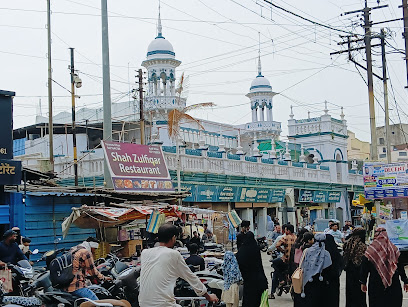
The Nearest Bus Stand is the Mohammad Ali Chowk Local Stop, situated at 0.1 km; the Nearest City Terminus is the Akola Central MSRTC Bus Stand, situated at 1.5 km, the Nearest Railway Station is the Akola Junction Railway Station (AK), situated at 1.8 km; the Nearest Domestic Airport is the Akola Airport (AKD) (Shivani), situated at 7.5 km. The Nearest International Airport is Dr Babasaheb Ambedkar International Airport, Nagpur (NAG), located 249.0 km from the mosque.
The Kacchi Masjid stands as a magnificent historical landmark, a premier house of Friday congregational worship, and an irreplaceable spiritual sanctuary situated at the iconic Mohammad Ali Chowk in the heart of Akola. Located within the culturally vibrant urban core of Maharashtra's Vidarbha region—historically noted for its position along ancestral central Indian trade routes and its deep-rooted multi-generational synthesis of Indo-Islamic cultures—this grand heritage mosque serves as a principal theological anchor. It guides the daily spiritual discipline and communal solidarity for local merchant families, residential quarters, and thousands of travellers. Historical and Religious Significance The grand mosque complex holds immense architectural, cultural, and theological prestige, acting as an active multi-generational hub for spiritual rectitude and local social welfare. The Legacy of Memon Mercantile Philanthropy: Locally revered as the Kacchi Masjid, the name carries a profound historical connection to the Cutchi Memon community (merchants originally hailing from the Cutch/Kutch region of Gujarat). Renowned across the Indian subcontinent for their business integrity and deep religious philanthropy, these elite traders migrated to Akola during the cotton boom of the late 19th and early 20th centuries. They established this grand mosque to serve as the ultimate theological and civic anchor for the rapidly expanding mercantile quarters. Establishment: Deeply woven into the late-colonial trading history of the region, the permanent grand masonry structural complex of the mosque was formally established in 1910. Constructed using traditional materials engineered to naturally withstand the intense dry heat of central India, the campus has been systematically preserved and updated internally by its hereditary trustees to safely handle large contemporary assemblies. Sunni Hanafi Traditions: Operating under the Ahlus Sunnat Wal Jama'at (Sunni Hanafi) school of jurisprudence, the mosque acts as a core theological authority for the local Jamaat, maintaining a highly disciplined and strictly punctual schedule for the five obligatory daily prayers (Salah). The Friday Congregational Assembly: As a premier central mosque (Badi Masjid), its weekly Friday Jumu'ah assemblies draw massive crowds from the surrounding commercial markets and bazaar lines. The sermons are delivered in clear, articulate Urdu, focusing deeply on personal moral rectitude, commercial honesty, social justice, and the practical application of faith within family and civic life. Educational and Social Anchor: The mosque administration effectively coordinates a well-structured evening Madrasa, ensuring that local youth receive a solid foundation in Quranic recitation, classical Arabic phonetics, and prophetic history. Concurrently, the managing trust functions as a central coordination point for localised philanthropic campaigns, managing extensive charity networks to distribute seasonal economic aid and food security relief to underprivileged families residing within the district. Ramadan and Civic Hospitality: During the holy month of Ramadan, the entire complex operates with spectacular spiritual vigour. It hosts extensive nightly Taraweeh prayers and coordinates large-scale, community-driven Iftar (fast-breaking) arrangements widely celebrated for serving traditional arrangements to support commuting merchants, travellers, and local families alike. Location and Accessibility: The grand heritage mosque is strategically positioned at the bustling commercial intersection of Mohammad Ali Chowk, making it a prominent municipal landmark while keeping the main inner prayer halls beautifully insulated from heavy street noise. Traveller's Note: The Kacchi Masjid features an awe-inspiring traditional Indo-Islamic architectural design characterised by high ceilings, thick masonry arches, elegant minarets, a striking central dome, and tidy, organised facilities for ritual purification (Wudu). Renowned across the district for its profoundly quiet, orderly, and deeply meditative environment, it provides an unparalleled journey into the living history of early Islamic heritage in Maharashtra. Visitors are cordially welcome for all five daily prayers, and traditional modest attire is expected when stepping inside the sacred premises.
Year of Built: 1910
Address: Kachchi Masjid Mohammad Ali Chowk
Country: India
State: Maharashtra
District: Akola
Pincode: 444006
Longitude: 76.99770409945322
Latitude: 20.7115068433472