
Indo Islamic Heritage


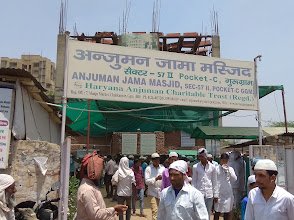
Anjuman Jama Masjid is a congregational mosque located on Dharm Marg, Block C, Sushant Lok III, Sector 57, Gurugram, Haryana. The address provided is Dharm Marg, Block C, Sushant Lok III, Sector 57, Gurugram, Haryana 122011, India. A current business listing confirms the mosque at this address and identifies it as a mosque, place of worship and non-governmental organisation. The mosque is associated with the Haryana Anjuman Charitable Trust (HACT). According to the Trust’s own website, Anjuman Jama Masjid was developed as a mosque for the growing Muslim population of New Gurgaon, with land acquired from the Haryana Government. The Trust describes the mosque as an important religious and community institution in the area.
Anjuman Jama Masjid is situated in Block C of Sushant Lok III, Sector 57, in the rapidly urbanised part of Gurugram commonly referred to as New Gurgaon. Its location on Dharm Marg places it within a predominantly residential and developing urban neighbourhood, making it accessible to residents and workers in the surrounding sectors. The mosque has a particular connection with the Haryana Anjuman Charitable Trust (HACT). According to the Trust’s official website, it is the first mosque established by the organisation in New Gurgaon and was developed on approximately 0.20 acre of land acquired from the Haryana Government. The Trust states that the mosque was established in response to the needs of the area’s growing Muslim population. As a Jama Masjid, the mosque serves a congregational function in addition to providing a regular place for daily worship. The five daily prayers—Fajr, Zuhr, Asr, Maghrib and Isha—form the basic religious activities associated with the mosque. Jumu’ah, the Friday congregational prayer, is particularly important at Anjuman Jama Masjid. The Trust specifically states that the mosque’s growing attendance has resulted in Jumu’ah prayers being conducted in two shifts, reflecting the demand for congregational space. The mosque also functions as a centre for religious discourse and community gatherings. HACT states that discourses on the life and teachings of the Prophet Muhammad ﷺ and prayer meetings for peace and prosperity are regularly held at the mosque. The Trust describes these meetings as open to people generally, giving the mosque a role extending beyond routine prayer. Another notable aspect of the institution is its connection with community welfare and education. According to HACT, the organisation operates a school for street children at the mosque, providing free education along with uniforms, books and nourishing snacks to children from neighbouring areas. This makes the mosque part of a wider charitable framework rather than functioning solely as a place of worship. The mosque’s community role is also connected with the Trust’s wider charitable activities. HACT states that it maintains a Muslim graveyard in the Sector 56/58 area and works to support neglected mosques and graveyards. It also describes operating a free dispensary in Chakkarpur village and an ambulance service, alongside activities intended to promote communal harmony. Quranic and religious education can therefore be understood within the broader educational and religious activities associated with the institution. However, specific details about Quran classes, the number of students or the current timetable of religious instruction were not independently verified and should not be treated as fixed facilities. The mosque is also likely to have increased significance during Ramadan, when congregational worship and religious gatherings generally become more frequent. The mosque’s role in daily prayers, religious discourses and community activities provides a natural setting for additional devotional and educational programmes during the month. Specific Ramadan programmes, however, can change from year to year. Similarly, Eid-ul-Fitr and Eid-ul-Adha are important occasions for the Muslim community. The mosque provides a central religious institution around which members of the surrounding community can organise worship and social interaction. The precise arrangements for Eid prayer at this mosque were not independently verified. Anjuman Jama Masjid is also notable for its location within Sushant Lok III, an urban locality of Sector 57. Directory sources place the mosque among the principal religious institutions serving the locality, while current business listings show substantial public engagement with the mosque. The mosque is listed as Sunni by Prayers Connect, although that directory itself cautions that some information about the mosque is still under review. It records the establishment date as unknown. There is therefore an important distinction between the mosque’s institutional history and its architectural history. The Trust provides documented information about its development and charitable activities, but I did not find reliable evidence establishing it as an ancient or heritage monument. Its importance is primarily connected with the development of New Gurgaon and the religious and welfare needs of its growing Muslim population. For a project documenting mosques in Haryana, Anjuman Jama Masjid can consequently be described as a modern congregational mosque and community institution in Sector 57, Gurugram, with documented links to the Haryana Anjuman Charitable Trust and a broader programme of religious education, charitable work and community welfare.
Year of Built: NA
Address: Dharm Marg, Block C, Sushant Lok III, Sector 57, Gurugram, Haryana 122011, India
Country: India
State: Haryana
District: Gurugram
Pincode: 122011
Longitude: 77.0895° E
Latitude: 28.4145° N