
Indo Islamic Heritage


Humayun’s Tomb is well-connected by various modes of transport in Delhi. The nearest railway station is Hazrat Nizamuddin, located about 2 km away. The closest metro station is JLN Stadium (Jawaharlal Nehru Stadium) on the Violet Line, approximately 1.5 km from the tomb. The nearest major bus stand is at Nizamuddin, offering convenient DTC bus services. For air travelers, the Indira Gandhi International Airport is around 18 km away, providing both domestic and international connectivity.
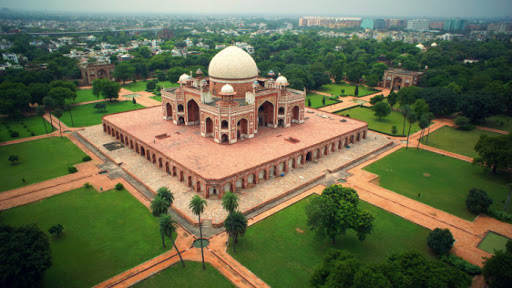
In India, the Char Bagh concept in imperial mausoleums is magnificently exemplified in Humayun’s Tomb in Delhi, which represents the first grand-scale Persian-style garden of its kind in South Asia. This quadrilateral layout, known as Char Bagh or "Four Gardens," was inspired by the Islamic vision of paradise and reflects the cultural legacy of Humayun’s father, Babur—the Central Asian conqueror who laid the foundation of the Mughal dynasty and became its first emperor. Constructed over eight years, the main tomb is set at the center of a 30-acre (120,000 m²) garden that is meticulously divided into four large squares by paved walkways, known as khiyabans, and bisected by two central water channels. These channels symbolize the four rivers of Jannat—the Islamic paradise—and appear to pass beneath the tomb and reemerge, creating a continuous line suggestive of Quranic verses that speak of rivers flowing beneath the Garden of Paradise. Each quadrant is further divided into smaller sections, forming a total of 36 geometrically precise squares, a hallmark of later Mughal garden design. The tomb structure itself occupies the intersection of the central axes, symbolically resembling a garden pavilion, but serving as the eternal resting place of the emperor. This fusion of garden and mausoleum conveys a powerful ideological message: while the garden represents sovereignty, the mausoleum embodies dynasty—together they assert the divine and eternal nature of kingship. The entire complex is enclosed by high rubble walls on three sides, with the Yamuna River once forming the natural boundary on the fourth side, though it has since changed course. The garden’s main walkways culminate at two gateways: the currently used double-storey West Gate and the now-closed South Gate, which served as the main entrance during the Mughal period. A baradari, a twelve-doored pavilion designed for airflow, stands at the center of the eastern wall, while a hammam, or bath chamber, is located along the northern wall—completing the architectural harmony of this regal resting place.
Year of Built: 16th Century
Address: Mathura Rd, Block A, Nizamuddin West, New Delhi, Delhi, India
Country: India
State: Delhi
District: South Delhi
Pincode: 110013
Longitude: 77.2507°
Latitude: 28.5933°