
Indo Islamic Heritage


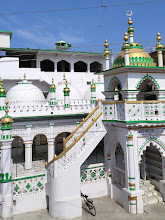
Nestled in the heart of Navratan Hatta, near the bustling Khazanchi Haat in Purnia, Jama Masjid stands as one of the area's most significant spiritual landmarks. With its elegant white façade and traditional minarets, this mosque serves as a central place of worship, welcoming hundreds for daily Salah, Jumu’ah prayers, and Ramadan taraweeh. A vital part of community life, the masjid is more than just a place for prayer—it hosts Qur’anic education for children, gatherings during Eid, and remains a timeless anchor of peace and togetherness in the city’s ever-changing rhythm.
In the vibrant lanes of Navratan Hatta, where old-world charm meets the pulse of a growing city, stands the venerable Jama Masjid, Khazanchi Haat—a spiritual center deeply woven into the life of Purnia. Located near the historical market of Khazanchi Haat, this mosque is not just an architectural fixture; it is the spiritual heartbeat of the neighborhood, witnessing the daily routines, joys, and solemnities of generations. The masjid’s exterior exudes calm authority—white-washed domes, finely arched doorways, and twin minarets that rise modestly into the skyline. It greets visitors with serenity, a peaceful counterpoint to the bustle of nearby vendors and commuters. As one enters through its arched gate, the noise of the world recedes—replaced by the rhythmic murmur of recitation, the soft whispers of du’a, and the occasional toll of footsteps on the mosque’s tiled courtyard. Inside, the main prayer hall accommodates nearly 300 worshippers, its walls adorned with subtle calligraphy and traditional Islamic motifs. Clean prayer rugs stretch in neat lines across the hall, guiding the congregation toward the mihrab—the spiritual center of the masjid. The wudu area, though simple, is meticulously maintained, ensuring worshippers can perform ablution in comfort and quiet focus. Every Friday, the mosque fills beyond capacity as worshippers from surrounding mohallas gather for Jumu’ah. The khutbah echoes with reminders of faith, patience, and justice. During Ramadan, the mosque becomes a luminous hub—hosting taraweeh prayers, iftar distributions, and late-night Qur’an recitations. Community elders recall how decades ago, the mosque was expanded brick by brick with local donations, each wall carrying the memory of labor and devotion. Children gather here in the evenings for maktab (basic Islamic education)—learning to read the Qur’an, memorize surahs, and understand basic tenets of Islam. Many of them also participate in naat competitions and Eid preparations, creating bonds that last well beyond their schooling years. What makes Jama Masjid Khazanchi Haat truly distinct is its people-centric identity. Managed by a local committee, it remains accessible, transparent, and inclusive. The mosque hosts community meetings, addresses local welfare needs, and facilitates charitable services—like distributing clothes and food to the needy, especially during the winter and Eid seasons. The masjid may not yet feature prominently online, but its offline presence is profound—etched into the memory of every resident who has paused here to reflect, pray, or seek solace. It stands not merely as a structure of faith, but as a living testimony to unity, resilience, and shared devotion in a fast-changing urban landscape.
Year of Built: Approx. 1970s–1980s
Address: Jama Masjid, Khazanchi Haat Navratan Hatta, Purnia, Bihar 854301, India
Country: India
State: Bihar
District: Purnia
Pincode: 854301
Longitude: 87.4762° E
Latitude: 25.7833° N