
Indo Islamic Heritage


_-_Kakanagar-_New_Delhi_-N-DL-5_.jpg)
.JPG)
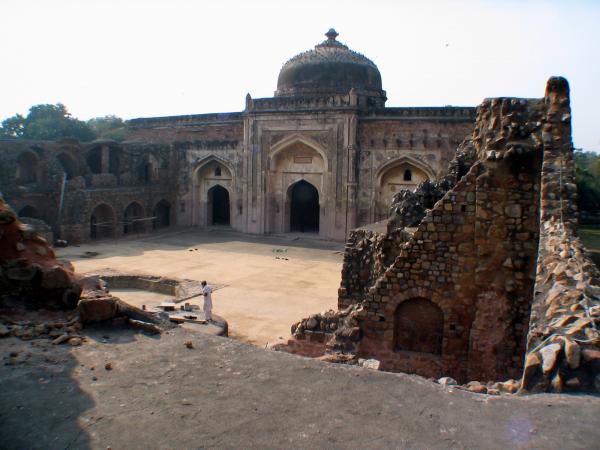
Khairul Manazil, or Khair-ul-Manazil, is an important historical mosque and madrasa located in New Delhi, India. It was built in 1561 and stands opposite Purana Qila on Mathura Road, southeast of Sher Shah Gate. The mosque showcases a blend of architectural styles, with the gateway constructed using red sandstone, adhering to the Mughal architectural tradition. The interior, however, incorporates elements of the Delhi Sultanate architecture, reflecting the transitional nature of the period. The mosque and madrasa complex is an example of the rich architectural heritage of the Mughal era, highlighting both the grandeur and intricacies of this era's design. The Nearest Bus Stand - Zoo, The Nearest Metro Station - Supreme Court , Nearest Railway Station- Hazrat Nizamuddin Railway Station Railway Station Nearest Airport- IGI
Khairul Manazil, built in 1561, is a significant historical structure commissioned by Maham Anga, one of the most influential and powerful women in Akbar's court. Maham Anga, who held the role of the Emperor?s wet nurse and foster mother, was a prominent figure in the Mughal Empire, and her involvement in the construction of the mosque and madrasa highlights her importance in the royal court. The mosque is located near Purana Qila on Mathura Road, southeast of Sher Shah Gate, and its historical importance is further deepened by an intriguing event in 1564. It is said that during this year, Emperor Akbar narrowly survived an assassination attempt while returning from the Nizamuddin Dargah. This attack occurred near the mosque, adding a layer of historical drama to the structure. Over time, the building transitioned into a madrasa, continuing its legacy as a center of education and learning. The mosque is notable not only for its historical significance but also for its architectural features. The gateway is made of red sandstone, showcasing the Mughal architectural style, while the interior reflects elements of the Delhi Sultanate?s design, indicative of the transitional period between these two great empires. Above the central gate, there is a marble plaque bearing Persian epigraphy, a chronogram that was composed by Maulana Shihabuddin Ahmad Khan, a court historian and poet in Akbar?s court. His pen name was Baazil, and he was also known for composing a eulogy on the tombstone of the famous poet Amir Khusrau, located at the shrine of Hazrat Nizamuddin, some two centuries after Khusrau?s death. The Persian epigraphy above the gate is particularly interesting because it contains a chronogram that translates the Arabic letters into their numerical equivalents using the rule of ٲٻڄݚ. This translation sums up to the numerals of the Hijri year 969, which corresponds to 1561 AD, the year the mosque was constructed. This inscription provides a direct link to the year of the building?s establishment, further cementing its historical relevance. Today, the structure is under the custodianship of the Archaeological Survey of India, ensuring its preservation as an important cultural and historical site.
Year of Built: 16th Century
Address: J65Q+2V5, Bapa Nagar, India Gate, New Delhi, Delhi
Country: India
State: Delhi
District: Central Delhi
Pincode: 110003
Longitude: 77.2394
Latitude: 28.6075