
Indo Islamic Heritage


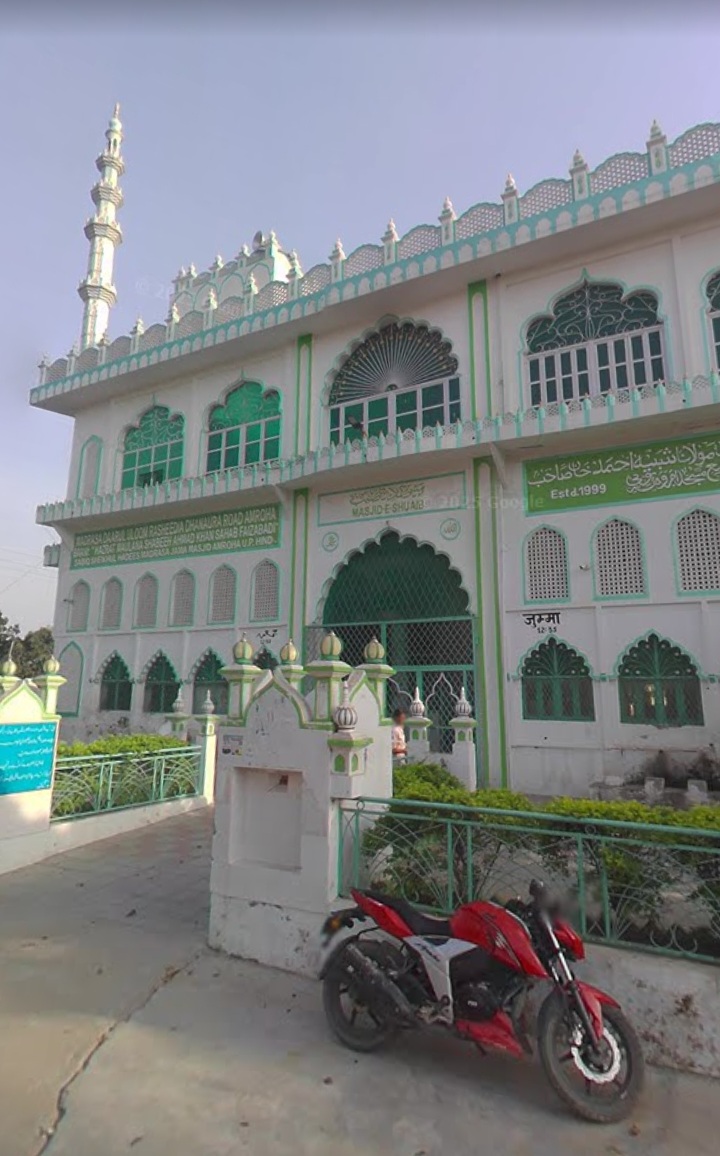
Masjid Madarsa Shuaib is a modest mosque and attached madrasa located in the rural village of Nizampur Garbi, near Amroha in Uttar Pradesh, India. It serves as a local center for Islamic worship and education, reflecting the region's historical Sufi and scholarly traditions. The structure embodies the cultural heritage of Muslim communities in the Rohilkhand area, where mosques often integrate educational facilities to promote religious learning and community cohesion. While specific historical records on its construction are limited, it aligns with Amroha's long-standing role as a hub for Islamic studies dating back centuries.
Masjid Madarsa Shuaib stands as a vital spiritual and educational landmark in Nizampur Garbi, a village in the Amroha district of Uttar Pradesh, nestled in the fertile plains of the Rohilkhand region. This mosque, integrated with a madrasa, exemplifies the traditional Islamic architectural and cultural ethos prevalent in northern India, where places of worship frequently double as centers for Quranic education and community gatherings. Amroha itself has a rich Islamic heritage, having served as a center of learning and Sufism since medieval times, as noted in historical texts like those by Mulla Abdul Qadir Badayuni, who received his education there. The mosque contributes to this legacy by providing a space for daily prayers, Friday congregations, and religious instruction, fostering values of faith, knowledge, and social harmony among local Muslim populations. The structure of Masjid Madarsa Shuaib, though not extensively documented in major historical accounts, follows the typical layout of rural Indian mosques: a simple prayer hall oriented toward the qibla (direction of Mecca), often with an ablution area and modest minarets or domes if present. The attached madrasa emphasizes traditional Islamic curriculum, including Quran recitation, Hadith studies, and basic jurisprudence, aligning with the broader network of madrasas in Uttar Pradesh that trace their roots to influential seminaries like Mazahir Uloom in nearby Saharanpur, founded in 1866. These institutions have historically played a pivotal role in preserving Islamic scholarship amid colonial and post-colonial challenges, promoting literacy and moral education in underserved rural areas. In Nizampur Garbi, the mosque-madrasa complex supports the local agrarian community, where handloom weaving and farming dominate, by offering free or low-cost religious education to children, thereby sustaining cultural identity in a diverse, multi-faith region. Historically, Amroha's significance as a Sufi hub—home to shrines like that of Sheikh Saddu and the revered Dargah of Syed Hussain Sharfuddin Shah Wilayat (a 13th-century saint)—underscores the mosque's cultural value. Built in an era when Mughal-era influences lingered, such mosques reinforced communal ties and interfaith respect, as evidenced by the saint Shah Wilayat's message of love across religions during the time of Emperor Babur. Masjid Madarsa Shuaib, while smaller in scale, upholds this tradition by serving as a beacon of piety and learning, contributing to the socio-religious fabric of Uttar Pradesh. Its endurance highlights the resilience of Islamic institutions in promoting peace and education, making it a symbol of historical continuity in a village that remains connected to Amroha's ancient scholarly past.
Year of Built: Not Available
Address: WC5X+CC5, Dhanaura Rd, Nizampur Garbi, Amroha, Uttar Pradesh 244221
Country: India
State: Uttar Pradesh
District: Amroha
Pincode: 244221
Longitude: 78.4675° E
Latitude: 28.9044° N