
Indo Islamic Heritage



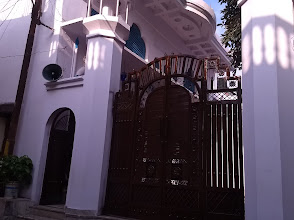
Azakhana Saddo, located in Mohalla Saddo, Amroha, Uttar Pradesh, is a historic Shia Muslim imambargah (congregation hall) centered around the tomb of Sheikh Saddo, a renowned 18th-century Muslim saint and wonder-worker (amil) known for his occult powers and mastery over jinns. Built as part of the older Kaiqubadi Masjid (commonly referred to as Saddo Masjid), it holds cultural significance as a site of interfaith pilgrimage, attracting Hindus, Sikhs, Sunni and Shia Muslims for rituals honoring Sheikh Saddo and his associated jinn spirit, Zain Khan. The site symbolizes syncretic traditions in North India, blending Islamic mysticism with folk practices, though it was officially closed in 1966 due to sectarian disputes and partially relocated to the nearby Vasudev Mandir. Its historical value lies in preserving Amroha's legacy as a hub of Shia Islam and shared devotional culture since the medieval period.
Azakhana Saddo stands as a poignant emblem of Amroha's rich Islamic heritage and syncretic spiritual traditions, embodying the town's longstanding role as a center of Shia devotion and intercommunal harmony in Uttar Pradesh. Amroha itself traces its origins to ancient times, with references in historical texts like Tarikh-i-Amroha indicating rule by Rajput dynasties from 676 to 1141 AD, followed by conquests under Mahmud of Ghazni in 1093 AD and integration into the Delhi Sultanate. By the Mughal era, the region flourished under Muslim governance, fostering a landscape dotted with mosques, imambaras, and dargahs that reflect the synthesis of Persianate Islamic culture with local Indian customs. Within this context, Azakhana Saddo emerged as a vital Shia institution, dedicated to mourning rituals (azadari) and veneration of saints, particularly during Muharram, when processions and majlis gatherings commemorate the martyrdom of Imam Husayn at Karbala. The azakhana's core revolves around Sheikh Saddo, a mid-18th-century Muslim saint from Amroha, revered for his mystical abilities as an amil (occult practitioner) who commanded jinns. According to local lore documented in ethnographic accounts, Sheikh Saddo formed a pact with a powerful jinn named Zain Khan but later severed it, leading to his death at the jinn's hands. Miraculously, the saint is believed to have subdued the spirit posthumously, establishing a dual cult that blends reverence for the holy man with appeasement of the supernatural entity. This narrative, rooted in 18th-century folk Islam, underscores the site's historical significance as a bridge between orthodox Shia practices and popular Sufi-folk traditions prevalent in North India. The tomb, housed within the Kaiqubadi Masjid (one of Amroha's oldest mosques, constructed in the 17th-18th century during Mughal influence), became a focal point for pilgrims seeking blessings for fertility, protection from evil, or material prosperity—such as lottery wins—while warding off jinn-induced afflictions like possessions, often affecting young women. Historically, Azakhana Saddo was co-managed by Sunni and Shia families, reflecting Amroha's diverse Muslim populace, which includes Naqvi Sayyids descended from 13th-century Sufi saint Syed Husain Sharaf-ud-din Shah Wilayat (whose nearby dargah is another key Shia site). The azakhana served as a venue for Muharram observances, including tazia processions and majlis, drawing devotees from across the region. Its cultural value amplified in the 19th and early 20th centuries, as Amroha emerged as a Shia stronghold amid the broader revival of azadari traditions post-Mughal decline. Pilgrims, including Hindus who venerate Sheikh Saddo as "Meera Baba," participated in weekly Tuesday rituals (Mian ki Jat) and the annual mela during the Hindu month of Jeth (May/June), celebrating the saint's birthday. This interfaith engagement highlights the site's role in fostering Ganga-Jamuni tehzeeb (Hindu-Muslim cultural synthesis), a hallmark of Uttar Pradesh's pluralistic ethos. However, the azakhana's trajectory took a contentious turn in the 1960s amid rising sectarian tensions. Disputes over ritual offerings and management rights between Shia Syeds and Sunni Sheikhs escalated, exacerbated by reformist Sunni groups like the Tablighi Jama'at, who sought to reclaim the site exclusively as a mosque. Fearing communal violence, authorities closed the Saddo Masjid in 1966, relocating much of the cult to the adjacent Vasudev Mandir, Amroha's largest Hindu temple. Legal battles ensued, but the courts avoided adjudication, leaving the original site in limbo. Today, a smaller number of pilgrims—primarily Shia Muslims—visit the closed masjid in Mohalla Saddo, while the Vasudev Mandir hosts broader interfaith gatherings, including Sikhs and Hindus, preserving the cult's essence without reported conflicts. Azakhana Saddo's enduring historical significance lies in its testament to Amroha's medieval Islamic legacy, from Sultanate-era mosques to Mughal-era Shia institutions, and its promotion of shared devotional spaces in a diverse society. As a repository of oral histories and rituals, it contributes to the cultural fabric of Uttar Pradesh, where Shia azadari has thrived since the 13th century, influencing poetry, marsiya recitations, and communal processions. Verified through archival sources like Tarikh-e-Amroha and ethnographic studies, the site remains a symbol of resilience, reminding us of the fluid boundaries of faith in India's syncretic landscape.
Year of Built: Not Available
Address: Mohalla Maja Pota, Mohalla Saddo, Amroha, Uttar Pradesh 244221
Country: India
State: Uttar Pradesh
District: Amroha
Pincode: 244221
Longitude: 78.4650° E
Latitude: 28.9024° N