
Indo Islamic Heritage


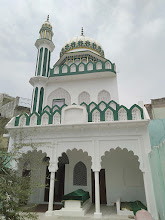
Dargah Hazrat Syed Mohammad Khaleel Kazmi Khaki (R.A.), also known as Allama Khaki, is a revered Sufi shrine in Mohalla Kutkai, Amroha, Uttar Pradesh, dedicated to the 20th-century Islamic scholar and spiritual guide Hazrat Allama Syed Muhammad Khaleel Kazmi (1896–1970). A descendant of Imam Musa Kazim (A.S.), he was a prominent figure in the Chishti and Qadri Sufi orders, known for his teachings on Islamic jurisprudence, spirituality, and devotion to the Prophet Muhammad (PBUH). The dargah complex includes his mausoleum and an associated mosque, serving as a center for prayer, Urs celebrations, and spiritual gatherings, reflecting Amroha's rich Naqvi Sadat heritage dating back to the 12th century.
The Dargah Hazrat Syed Mohammad Khaleel Kazmi Khaki (R.A.) stands as a beacon of Sufi spirituality in the historic town of Amroha, Uttar Pradesh, embodying the enduring legacy of Islamic scholarship and devotion within the Naqvi Sadat community. Amroha, settled by Naqvi Sayyids from Wasit, Iraq, since 1190 CE, has long been a hub of Sufi influence under Mughal patronage, where families like the Kazmis contributed to religious and cultural life through military service, education, and spiritual guidance. This dargah honors Hazrat Allama Syed Muhammad Khaleel Kazmi, affectionately known as Allama Khaki or Khwaja Siraj-ud-Deen, a 20th-century luminary whose life bridged traditional Islamic learning with Sufi mysticism, fostering unity and piety amid India's diverse cultural landscape. Born on 1 Shawwal 1313 Hijri (16 March 1896 CE) in Mohalla Kutkai, Amroha (then part of Moradabad district), Syed Muhammad Khaleel Kazmi was a Husaini Sayyid, tracing his lineage directly to Imam Musa Kazim (A.S.), the seventh Shia Imam, through 35 generations. His father, Maulana Syed Muhammad Mukhtar Ahmad Kazmi, was a respected scholar, and his family upheld a tradition of religious education. From a young age, Khaleel displayed prodigious intellect; upon his birth, relatives like Hafiz Yakub Ali and Peer Sha Ji Ghulam Haider prophesied his role as a family beacon and spiritual successor. He received early education at Madrasa Mohammadiya in Amroha, excelling in Quranic studies, Hadith, and Fiqh. By 1344 Hijri (1926 CE), he earned his Sanad-e-Faraaghat and began teaching there, later serving as a mudarris (teacher) at institutions like Dar-ul-Uloom Nomaniya in Lahore. Allama Khaki's spiritual journey deepened through initiation into the Chishti Sabri and Qadri orders, earning him titles like Qudwat us Salikeen (Exemplar of the Seekers), Zebatul Aarifeen (Ornament of the Knowers), and Khatim ul Muhaddiseen (Seal of the Revivers). He emphasized Ishq-e-Rasool (love for the Prophet Muhammad, PBUH), tauheed (monotheism), and practical devotion, authoring works on Quranic exegesis, Prophetic biography, and Sufi ethics. His teachings promoted interfaith harmony, drawing from Amroha's syncretic traditions where Sayyids integrated local customs while preserving Islamic orthodoxy. As a khalifa (spiritual successor), he guided disciples across India and Pakistan, including his brother Syed Ahmad Saeed Kazmi (Ghazali-e-Zaman), who migrated to Multan in 1935 and contributed to the Pakistan Movement. The dargah's historical significance lies in its role as a post-Partition spiritual anchor for the Amrohi Sayyids, many of whom resettled in Pakistan but maintained ties to Amroha's shrines. Following Allama Khaki's wafat (passing) on 27 Ramadan 1390 Hijri (28 November 1970 CE) in Amroha—after returning from Pilibhit amid illness while reciting the Quran—the mausoleum was established in Mohalla Kutkai as a site for ziarat (visitation). The annual Urs, marking his death anniversary, attracts devotees for qawwali, prayers, and faizan (spiritual blessings), reinforcing Amroha's status as a Sufi center alongside shrines like that of Syed Sharfuddin Shah Wilayat (13th century). The complex symbolizes resilience, as Amroha's Sayyid gentry protected the region from Maratha invasions in the 18th century through valor and diplomacy. Central to the dargah is its mosque, integral to the saint's legacy of Islamic propagation. Constructed or formalized post-1970 adjacent to the mausoleum, the mosque reflects simple Mughal-influenced architecture typical of Amroha's Naqvi endowments—whitewashed walls, arched mihrabs, and minarets for the adhan. It serves as a masjid for daily salah, Jumu'ah prayers, and Ramadan taraweeh, accommodating local worshippers and pilgrims. No specific pre-1970 construction records exist, but it aligns with family traditions of building madrasas and mosques, as seen in Allama Khaki's own educational initiatives. The mosque hosts scholarly discourses on Tafsir and Hadith, echoing his role in reviving Sunnah practices. Its serene courtyard, often adorned with chadar offerings during Urs, fosters communal iftar and dhikr sessions, promoting the Chishti emphasis on love, tolerance, and service—values that sustained Amroha's multicultural fabric under Mughal, British, and post-independence rule. Culturally, the dargah and mosque preserve Amroha's Naqvi heritage, where Sayyids like the Kazmis blended Persian scholarship with Indian ethos, influencing Urdu poetry, music, and philosophy. Annual events draw Hindus and Muslims, underscoring Sufism's role in India's syncretic history. Today, under Sajjada Nashin Hazrat Maulana Noor-ul-Ameen Kazmi (a khalifa and grandson-in-law), it continues as a living testament to spiritual revival, with verified descendants maintaining its traditions. This site not only honors Allama Khaki's contributions but also enriches Uttar Pradesh's tapestry of faith, inviting reflection on unity in diversity.
Year of Built: Not Available
Address: WF6F+Q67, Near Zaifiya Masjid,Chaupal, Mohalla, Katkui, Amroha, Uttar Pradesh 244221
Country: India
State: Uttar Pradesh
District: Amroha
Pincode: 244221
Longitude: 78.46984° E
Latitude: 28.90314° N