
Indo Islamic Heritage


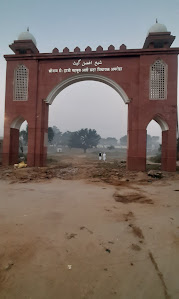
Eidgah Amroha, located in Islam Nagar, Amroha, Uttar Pradesh, is a historic open-air prayer ground serving as a central site for Eid prayers in the Muslim community. It embodies the rich Islamic heritage of the region, reflecting centuries of cultural and religious continuity in Amroha, a city with deep historical roots dating back to the Delhi Sultanate and Mughal eras. The Eidgah stands as a symbol of communal unity and spiritual significance, attracting worshippers for major Islamic festivals.
The Eidgah in Islam Nagar, Amroha, represents a vital element of Uttar Pradesh's Islamic architectural and cultural legacy, serving as an open enclosure dedicated to congregational prayers during Eid al-Fitr and Eid al-Adha. Amroha, historically part of the Sambhal sarkar under the Mughal Empire, has been a hub of Muslim settlement and scholarship since the 13th century, with influences from Sufi saints like Syed Sharfuddin Shah Wilayat, who migrated from Iraq and contributed to the region's spiritual landscape. The Eidgah, typical of Indo-Islamic design, features a simple yet functional structure with a qibla wall oriented towards Mecca, allowing large gatherings for prayer without the enclosure of a full mosque. Its location in Islam Nagar, a predominantly Muslim locality, underscores its role in fostering community bonds and preserving religious traditions amid the city's evolution from a Rajput-ruled area in the medieval period to a Mughal stronghold. Historically, Amroha's Islamic sites, including mosques, idgahs, and imambaras, emerged during the Delhi Sultanate and flourished under Mughal patronage. The construction of the Eidgah likely occurred in the 17th or 18th century, contemporaneous with other monuments like the Moradabadi Darwaza built in 1642 by Saiyid Abdul Majid under Emperor Shah Jahan. This period saw the erection of several prayer structures across the region to support the growing Muslim population, which today constitutes a significant portion of Amroha's demographics. The Eidgah's design emphasizes openness and accessibility, characteristic of early Eidgahs in the Indian subcontinent, which were often built on the outskirts of settlements to accommodate crowds. It remains a site of cultural value, hosting not only prayers but also reinforcing the Ganga-Jamuna tehzeeb—the syncretic Hindu-Muslim cultural harmony prevalent in Amroha. In terms of significance, the Eidgah contributes to Amroha's identity as a center of Islamic learning and observance, complementing nearby structures like the Dargah of Shah Wilayat and various mosques from the Sultanate era. Its endurance through historical upheavals, including the transition from Mughal to British rule in 1801, highlights its role in maintaining religious continuity. Today, it continues to draw locals and visitors, symbolizing resilience and devotion in the face of modern changes, while standing as a testament to the architectural simplicity and spiritual depth of Islamic heritage in Uttar Pradesh.
Year of Built: Not Available
Address: 26, Islam Nagar, Amroha, Uttar Pradesh 244221
Country: India
State: Uttar Pradesh
District: Amroha
Pincode: 244221
Longitude: 78.4673° E
Latitude: 28.9044° N