
Indo Islamic Heritage


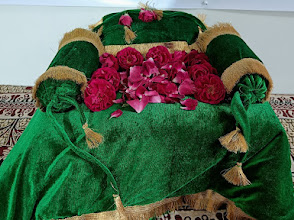
Azakhana Zehra is a historic Shia Islamic shrine and assembly hall (azakhana or imambargah) located in the Guzri Mohalla neighborhood of Amroha, Uttar Pradesh. It serves as a key site for Muharram observances, where the Shia community gathers for majlis (mourning assemblies) and processions commemorating the martyrdom of Imam Hussain. The structure is part of Amroha's rich Islamic heritage, reflecting the town's longstanding Shia traditions dating back to the Mughal era. It is situated in a densely populated Muslim locality known for its communal unity and religious sites.
Azakhana Zehra stands as a significant historical Islamic site in Amroha, a town renowned for its deep-rooted Shia Muslim heritage and contributions to Islamic scholarship and culture in northern India. Constructed in 1802 (corresponding to 1226 Hijri in the Islamic calendar), the azakhana was established as a dedicated space for Shia religious practices, particularly during the sacred month of Muharram. This period marks the annual commemoration of the Battle of Karbala in 680 CE, where Imam Hussain, the grandson of Prophet Muhammad, was martyred along with his companions. The site was built amid Amroha's evolution as a center of Shia activity, influenced by the migration of Sufi saints and scholars from Iraq and Persia during the medieval period, and further supported by the Nawabs of Awadh, who promoted Shia traditions in the region. The azakhana's architecture, though modest compared to grander imambargahs in Lucknow, exemplifies the Indo-Islamic style prevalent in 19th-century Uttar Pradesh. It features a spacious hall designed for large gatherings, with elements such as arched entrances, intricate stucco work on the walls, and a central podium (mimbar) for recitations of marsiya (elegies) and noha (lamentations). Adjoining the main structure is a mosque, constructed concurrently, which serves daily prayers and reinforces the site's dual role as both a place of worship and communal mourning. The building's layout allows for the display of alams (standards symbolizing the martyrs of Karbala) and tazias (replicas of the Imam's tomb), which are central to Muharram processions starting from or passing through Guzri Mohalla. Historically, Azakhana Zehra has been integral to Amroha's Shia community life, which forms a substantial portion of the town's 70% Muslim population. Amroha, founded around 479 BCE but flourishing under Islamic rule from the Delhi Sultanate onward, became a hub for Shia observances following the settlement of descendants of Imam Ali in the 13th century, including the revered Sufi saint Syed Husain Sharaf-ud-din Shah Wilayat. The azakhana's establishment in 1802 reflects the socio-religious dynamics of the time, when local Shia families, often of Sayyid lineage, commissioned such structures to preserve rituals like matam (self-flagellation) and juloos (processions). During the 8th of Muharram, it serves as a starting point for the Zanjeer ka Matam (chain-beating procession), a poignant ritual symbolizing mourning for Imam Hussain. The site also hosts daily majlis at 4:00 PM during Muharram and 10:00 AM in Safar, along with events like Shab-e-Bedari (night vigil) on the 14th of Safar and taziya processions on the 10th and 20th of Muharram. Located in Guzri Mohalla, a historic neighborhood inhabited by Sayyid families tracing their roots to early Islamic settlers, Azakhana Zehra embodies the town's Ganga-Jamuna tehzeeb (syncretic Hindu-Muslim culture). The mohalla itself, with its narrow lanes and communal courtyards, has preserved Shia traditions for generations, including the recitation of Amroha-specific marsiya like "Qaid se choot ke Jab Syed-e-Sajjad aaye." The site's coordinates (28.9044° N, 78.4675° E) place it in the heart of Amroha, near the Sot River and key landmarks like the railway station, facilitating its role in larger religious events. With a pincode of 244221, it remains accessible via Amroha's road and rail networks, connected to NH-24. Today, Azakhana Zehra continues to function as a vital religious and cultural landmark, drawing devotees for its spiritual significance and historical authenticity. Maintained by local Shia trusts, it underscores Amroha's legacy as a cradle of Islamic devotion, where structures like this have endured colonial transitions and modern developments while fostering community bonds through shared rituals. Visitors and scholars alike recognize it as a testament to the resilience of Shia Islam in India, with no recorded alterations to its core purpose since its founding.
Year of Built: Not Available
Address: H. No 24, Guzri Mohalla, Chatta, Amroha, Uttar Pradesh 244221
Country: India
State: Uttar Pradesh
District: Amroha
Pincode: 244221
Longitude: 78.4675° E
Latitude: 28.9044° N