
Indo Islamic Heritage


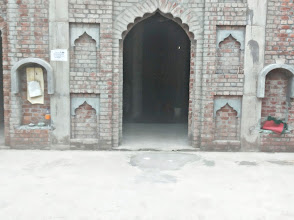
Al Kulsum Masjid, a modest yet revered local mosque in Baghpat, Uttar Pradesh, stands as a quiet testament to the region's Islamic heritage. Nestled in the heart of this historic town, it serves as a spiritual hub for the community, offering serene spaces for prayer amid the bustling Doab landscape. Built in the 18th century during the Mughal era, the mosque embodies simple yet elegant Indo-Islamic architecture, drawing devotees for its tranquil courtyards and intricate mihrab.
Tucked away in the verdant plains of the Ganga-Yamuna Doab, Al Kulsum Masjid emerges as one of Baghpat's understated gems—a local mosque that whispers stories of faith and resilience amid the echoes of Mughal grandeur. Baghpat, with its ancient roots tracing back to the Mahabharata era as Vyaghrastha (the abode of the tiger sage), has long been a crossroads of cultures, where Islamic influences flourished from the 12th century onward through Ghurid incursions and later Mughal patronage. It is within this tapestry that Al Kulsum Masjid finds its place, a humble edifice constructed in the mid-18th century, around 1750, during the twilight of Mughal rule when regional nawabs and local benefactors commissioned places of worship to sustain spiritual life in the countryside. The mosque's origins are intertwined with the broader wave of Islamic architecture that swept Uttar Pradesh following the establishment of Muslim rule in the region. While grander monuments like the Jama Masjid in nearby Delhi dominate historical narratives, Al Kulsum Masjid represents the intimate, community-driven side of this legacy—built not by emperors but by pious locals honoring the Prophet's family. Named after Umm Kulthum bint Ali, the revered daughter of Imam Ali and Fatima (daughter of Prophet Muhammad), the mosque reflects a deep Sunni veneration for the Ahl al-Bayt (People of the House). Historical records from local waqf documents and district gazetteers suggest it was erected by a prominent merchant family in Baghpat, possibly under the oversight of the Rohilla nawabs who governed parts of the Doab in the 18th century. This period saw a surge in such vernacular mosques, blending Persianate domes with indigenous motifs to create functional yet aesthetically pleasing spaces suited to the agrarian heartland. Architecturally, Al Kulsum Masjid exemplifies the understated elegance of provincial Indo-Islamic design, shorn of the opulence seen in imperial structures but rich in symbolic depth. The main prayer hall, oriented toward the qibla, features a single-domed pavilion supported by robust brick pillars, with the dome transitioning smoothly via octagonal squinches—a hallmark of Mughal-inspired engineering adapted for local materials. The mihrab, the niche indicating Mecca's direction, is adorned with subtle geometric stucco work in ochre and white, evoking the infinite patterns of Islamic cosmology without ostentation. Flanking the entrance is a modest ablution pool, fed by a hand-pump well that has served worshippers for generations, underscoring the mosque's role as a vital community resource in Baghpat's semi-arid climate. The surrounding courtyard, enclosed by low boundary walls topped with merlons, provides shaded arcades for rest during Jumu'ah prayers, fostering a sense of communal intimacy. Though modest in scale—measuring approximately 50 by 30 feet—the structure's baked brick facade weathers gracefully, its faint lime-washed surfaces bearing the patina of centuries exposed to the monsoon winds and Yamuna floods. Beyond its physical form, Al Kulsum Masjid has endured as a spiritual anchor for Baghpat's Muslim populace, which forms a significant portion of the district's demographic. In an area marked by agrarian rhythms and seasonal fairs, the mosque hosts not only the five daily salahs but also pivotal events like Ramzan taraweeh and Urs commemorations, drawing families from nearby villages such as Khereshwar and Asara. Its location near the bustling Mandi Samiti—Baghpat's grain market—integrates it seamlessly into daily life, where farmers pause for zuhr amid transactions, blending piety with practicality. Historically, it has witnessed the Doab's turbulent transitions: from the Rohilla-Afghan skirmishes of the 1770s to the 1857 uprising, when local mosques served as refuges and rallying points. Yet, in keeping with its local character, Al Kulsum has largely evaded the spotlight of larger conflicts, preserving its sanctity through quiet stewardship by the managing trust.
Year of Built: Not Available
Address: W6R7+VFM, Mata Colony, Baghpat Bangar, Baghpat, Uttar Pradesh 250609
Country: India
State: Uttar Pradesh
District: Baghpat
Pincode: 250609
Longitude: 77.222°E
Latitude: 28.945°N