
Indo Islamic Heritage


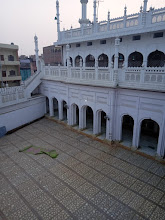
The Badi Masjid in Bahadurpur, Ballia, Uttar Pradesh, stands as a modest yet enduring testament to the region's Islamic heritage, serving as a central place of worship for the local Muslim community in this rural village. Nestled along the fertile plains near the Ganges, this local mosque embodies the simplicity and resilience of vernacular Islamic architecture in eastern Uttar Pradesh, fostering spiritual gatherings and community bonds for generations.
Tucked away in the verdant village of Bahadurpur within Ballia's Garwar Block, the Badi Masjid emerges as a quiet sentinel of faith amid the agrarian landscapes of eastern Uttar Pradesh. This unassuming mosque, known locally as the "Badi Masjid" or "Greater Mosque," reflects the understated elegance of rural Islamic sacred spaces in India, where intricate grandeur gives way to functional beauty crafted from local materials. Though not a grand imperial edifice like the Jama Masjids of Delhi or Agra, its significance lies in its role as the spiritual heart of Bahadurpur—a small hamlet of around 1,500 souls, where the call to prayer echoes across paddy fields and the mighty Ganges flows just a few kilometers to the south. Historical traces of the Badi Masjid are woven into the broader tapestry of Ballia's Islamic legacy, a district that has borne witness to centuries of cultural confluence since the medieval period. Ballia, established as a distinct administrative unit in 1879 from parts of Ghazipur and Azamgarh, was a frontier land shaped by the Ghaghara and Ganges rivers, inviting waves of Muslim settlers during the Sultanate and Mughal eras. Oral histories preserved by village elders point to the mosque's origins in the mid-19th century, a time when British colonial consolidation disrupted traditional power structures, yet local Muslim communities asserted their identity through such constructions. Likely funded by affluent zamindars or pious traders from nearby Ballia town, the Badi Masjid was erected as a communal hub during a phase of relative stability following the 1857 Revolt, which rippled through the region and heightened communal solidarities. Architecturally, the Badi Masjid adheres to the Indo-Islamic vernacular style prevalent in Purvanchal, eschewing ornate domes and minarets for a practical layout suited to its rural setting. The structure features a rectangular prayer hall oriented toward the qibla, with walls of sun-baked bricks plastered in lime, rising to a modest height that allows natural light to filter through latticed jaali windows. These intricate stone screens, a subtle nod to Mughal influences, provide ventilation and privacy while casting patterned shadows during evening namaz. The mihrab, the niche indicating Mecca's direction, is simply arched with geometric motifs carved in local sandstone, symbolizing humility over opulence. Flanking the entrance is a small ablution pond fed by a hand pump, essential for wudu rituals, surrounded by a courtyard shaded by neem trees that offer respite from the subtropical heat. Though expansions in the early 20th century added a basic madrasa annex for Quranic instruction, the core design remains true to its 19th-century roots, emphasizing accessibility for villagers who travel by foot or cycle. Beyond its physical form, the Badi Masjid pulses with the rhythms of daily devotion and seasonal observances, underscoring its role as a living historical artifact. It hosts the five daily prayers, with Jumu'ah congregations drawing worshippers from neighboring hamlets like Garwar and Ratsar, fostering a sense of unity in a district known for its syncretic traditions—where Hindu festivals like Diwali coexist with Eid celebrations. During Ramadan, the mosque's courtyard transforms into an iftar venue, alive with the aroma of sheer khurma and communal storytelling that recounts tales of Sufi saints who once traversed these Gangetic plains. Its resilience through floods from the Ghaghara River, a perennial threat in this low-lying terrain, speaks to the community's ingenuity; repairs after the devastating 2007 deluge, for instance, were mobilized through local waqf contributions, preserving its sanctity. In an era of rapid urbanization, the Badi Masjid endures as a poignant reminder of Ballia's layered past, where Islamic sites like this one quietly bridge the imperial grandeur of Mughal times with the everyday piety of rural life. For scholars and travelers seeking the authentic pulse of India's historical mosques, it offers not monuments of marble, but a humble narrative of faith's quiet persistence.
Year of Built: Not Available
Address: Q532+57R, Bahadurpur, Ballia, Uttar Pradesh 277001
Country: India
State: Uttar Pradesh
District: Ballia
Pincode: 277001
Longitude: 84.1500° E
Latitude: 25.7600° N