
Indo Islamic Heritage


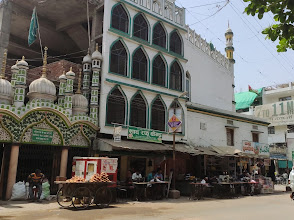
Nestled in the quiet village of Bahadurpur within Ballia district, the Bishnupur Jama Masjid stands as a modest yet enduring symbol of local Islamic heritage. This unassuming Friday mosque serves as the spiritual heart of the surrounding Muslim community, reflecting the simple yet resilient faith practices in rural Uttar Pradesh. Though not a grand monument, it embodies the everyday sanctity of prayer and communal gathering in a region shaped by the Ganges' fertile plains.
In the verdant expanse of Ballia's Hanumanganj block, where the Ganges whispers tales of ancient migrations and shared histories, the Bishnupur Jama Masjid emerges as a humble testament to the enduring presence of Islam in eastern Uttar Pradesh. Located in the village of Bahadurpur—a small hamlet just 5 kilometers west of Ballia town—this local jama masjid is more than a place of worship; it is the quiet anchor of a community woven into the fabric of rural life. Its precise coordinates at 25.7585° N, 84.1489° E place it amid the alluvial soils that have sustained generations, near the banks of the sacred river that has long influenced the spiritual landscape of the Purvanchal region. While grander mosques like the Jama Masjid of Jaunpur or Delhi's iconic edifice capture the imagination with their imperial splendor, the Bishnupur Jama Masjid tells a story of grassroots devotion. Constructed likely in the late 19th or early 20th century—a period when Islamic communities in Ballia flourished under British colonial influences and local zamindari patronage—the mosque's origins remain rooted in oral traditions passed down through village elders. No ornate inscriptions or royal decrees mark its walls, but its very existence speaks to the migratory waves of Muslim artisans and traders who settled in these Ganges-adjacent villages during the Mughal era's twilight and the subsequent Nawabi influences from nearby Awadh and Bengal. Architecturally, the masjid adheres to the understated vernacular style prevalent in rural Uttar Pradesh: a rectangular prayer hall with whitewashed walls of local brick and lime plaster, topped by a modest dome or flat roof that blends seamlessly into the surrounding thatched homesteads. The mihrab, facing Mecca, is a simple arched niche adorned perhaps with subtle geometric motifs—a nod to the broader Indo-Islamic aesthetic without the flourish of urban counterparts. Flanking the entrance, one might find arched verandas for ablutions, where villagers gather before the adhan echoes across the fields at dawn and dusk. Though not documented in national heritage lists, its role as a jama masjid underscores its centrality to Friday congregational prayers, fostering unity in a diverse agrarian society where Hindus and Muslims have coexisted for centuries. The mosque's pincode, 277001, ties it to Ballia's bustling post office hub, a reminder of its integration into modern postal networks that carry letters and remittances from distant kin. Yet, its true historical significance lies in its quiet resilience: through the famines of the colonial era, the fervor of India's independence movement, and the social upheavals of post-Partition realignments, it has remained a steadfast space for reflection and ritual. Local lore, preserved in community narratives, hints at expansions funded by devout patrons in the early 1900s, perhaps to accommodate growing congregations drawn by Ballia's strategic position on trade routes linking Varanasi and Bihar. Today, the Bishnupur Jama Masjid continues to pulse with life—children reciting Quranic verses under shaded neem trees, elders sharing stories of bygone eras, and families marking Eid with shared iftars. In an age of rapid urbanization, it stands as a preserved fragment of Ballia's Islamic soul, inviting reflection on how faith manifests not in marble grandeur, but in the simple act of prostration amid the everyday rhythms of village India. For those tracing the lesser-known threads of the subcontinent's religious tapestry, this unpretentious sanctuary offers a poignant glimpse into the lived history of Islam's heartland.
Year of Built: Not Available
Address: Q44X+M6, Bahadurpur, Ballia, Uttar Pradesh 277001
Country: India
State: Uttar Pradesh
District: Ballia
Pincode: 277001
Longitude: 84.1489° E
Latitude: 25.7585° N