
Indo Islamic Heritage


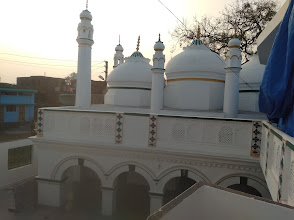
Reoti Badi Masjid, known locally as the "Great Mosque," is a modest yet enduring Islamic place of worship in the town of Reoti, Ballia district. Nestled in the flood-prone Gangetic plains, this local landmark serves as a spiritual hub for the Muslim community, reflecting the town's resilient history amid its revolutionary past.
Tucked away in the heart of Reoti, a nagar panchayat in eastern Uttar Pradesh's Ballia district, the Reoti Badi Masjid stands as a quiet testament to the region's layered Islamic heritage. Reoti, situated on the eastern bank of the expansive Reoti Dah lake—a vast, seasonal water body that shapes the low-lying, swampy terrain—has long been a crossroads of cultural and spiritual influences. The mosque, often simply called "Badi Masjid" or the Great Mosque by locals, occupies a central position in Gudari Bazar, the town's bustling cloth and market quarter, where the hum of daily commerce blends seamlessly with the calls to prayer echoing from its minarets. Though precise records of its construction remain elusive in historical archives, the mosque's design points to a 19th-century origin, aligning with the broader wave of local Islamic architecture that emerged during the late Nawabi and early British colonial periods in the Gangetic heartland. Ballia district itself traces its administrative roots to 1879, carved from Ghazipur and Azamgarh, but the area's Islamic presence dates further back, influenced by the Mughal suzerainty under emperors like Chandradeva and the Maukharis of Kannauj in the 6th century. By the 19th century, as Reoti evolved into a modest trading post known for shoemaking, palanquin crafting, and vegetable cultivation, the Badi Masjid likely served as a communal anchor for the growing Muslim population, fostering prayer, education, and social gatherings. Architecturally, the mosque embodies the unpretentious vernacular style typical of rural Uttar Pradesh—simple brick walls rising to a modest dome and flanked by slender minarets that pierce the hazy skyline. Its prayer hall, oriented toward Mecca, features arched mihrabs and geometric motifs etched in lime plaster, evoking the understated elegance of provincial Mughal derivatives rather than the grandeur of urban counterparts like Delhi's Jama Masjid. The courtyard, though compact, invites serene reflection, shaded by neem trees that whisper against the seasonal monsoons. Over time, the structure has weathered floods from the nearby Ganges and Ghaghara rivers, which define Ballia's eastern boundary with Bihar, yet it endures as a symbol of continuity. Beyond its physical form, the Badi Masjid is woven into Reoti's fabric of quiet devotion and shared memory. In a town that achieved a symbolic independence from British rule in 1942—five years before India's nationwide freedom—the mosque would have been a refuge during turbulent times, including the 1930 Salt Satyagraha when locals in Reoti defied colonial salt laws alongside nearby Rasra and Bansdih. Today, it remains a vital space for the five daily salah, Friday jumu'ah congregations, and Ramadan iftars, drawing worshippers from Reoti's approximately 26,000 residents. Its location near the Reoti railway station, just 800 meters south, underscores its accessibility, connecting it to the broader pilgrim and trade routes linking Ballia to Varanasi, 140 kilometers west. As a local gem rather than a national monument, Reoti Badi Masjid quietly preserves the essence of India's syncretic Islamic traditions—humble, resilient, and deeply rooted in community life. For visitors seeking the authentic pulse of rural devotion amid the Gangetic plains, it offers not just architectural insight but a poignant glimpse into the enduring spirit of faith in one of Uttar Pradesh's overlooked corners.
Year of Built: Not Available
Address: V92H+43P, Bhasha, Reoti, Uttar Pradesh 277209
Country: India
State: Uttar Pradesh
District: Ballia
Pincode: 277209
Longitude: 84.378° E
Latitude: 25.851° N