
Indo Islamic Heritage


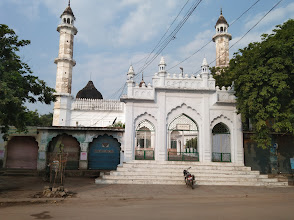
The Jama Masjid at Gular Naka in Banda, Uttar Pradesh, stands as a modest yet enduring symbol of the region's Islamic heritage. Nestled near the bustling Banda Railway Station, this local Friday mosque serves as a vital community hub for prayer and reflection, reflecting the syncretic cultural fabric of Bundelkhand amid its colonial and post-independence history. With its simple architecture and central location, it embodies the quiet resilience of everyday faith in a historically layered landscape.
Perched at the heart of Gular Naka—a vibrant intersection named after the ancient Indian jujube (ber) trees that once dotted the Bundelkhand plains—the Jama Masjid emerges as a understated beacon of Islamic devotion in the rugged terrain of Banda district. This unassuming Friday mosque, often simply referred to as the local Jama Masjid, occupies a prominent spot adjacent to the Banda Junction Railway Station, where the rhythmic clatter of trains echoes the pulse of daily life. Built during a period when the British East India Company was consolidating control over the Bundelkhand region following the 1857 Revolt, the mosque's origins are intertwined with the influx of Muslim traders, artisans, and administrators who settled here to support the colonial economy centered on agriculture and quarrying of the famed Banda quartzite stone. Historically, Banda's landscape bears the imprints of successive rulers—from the Chandela Rajputs who fortified nearby Kalinjar in the 11th century, to the Mughals who briefly asserted influence in the 16th century, and finally the British who established Banda as a tehsil headquarters in 1807. The Jama Masjid, though not a grand imperial edifice like its counterparts in Delhi or Agra, represents the grassroots evolution of Islamic architecture in provincial India. Constructed likely in the 1840s or 1850s, it draws from vernacular Indo-Islamic styles prevalent in Uttar Pradesh's heartland: sturdy brick walls plastered with lime, a modest central dome evoking the onion-shaped motifs of Mughal design, and flanking minarets that rise just enough to call the faithful to prayer without overwhelming the modest skyline. The prayer hall, oriented precisely toward Mecca, features a serene mihrab niche adorned with subtle geometric stucco work, while the open courtyard—framed by arched verandas—accommodates the Friday congregations that swell with locals from surrounding villages. What elevates this mosque beyond its functional role is its role as a living archive of Banda's multicultural ethos. In a district where Hindu temples like the ancient Bhitauli Ghat shrines coexist harmoniously with Islamic sites, the Jama Masjid has quietly facilitated interfaith dialogues for generations. During the British era, it served not only as a place of worship but also as a community gathering point for discussions on land reforms and the indigo trade that bound the region's farmers to distant markets. Post-independence, amid the green revolution's transformations, it became a space for social welfare initiatives, hosting iftar gatherings during Ramadan and educational programs under the local waqf board. The mosque's architecture, though weathered by the subtropical climate's monsoons and dust storms, retains an authenticity unmarred by later embellishments—its ablution pool, fed by a simple rainwater harvesting system, whispers of sustainable practices rooted in Islamic tradition. Today, the Jama Masjid continues to anchor the spiritual life of Gular Naka's diverse populace, drawing worshippers from the nearby railway colony and the labyrinthine lanes of Banda's old town. As trains rumble past, carrying pilgrims to sacred sites like Chitrakoot—Lord Rama's fabled forest exile—the mosque stands as a testament to Islam's deep-rooted presence in Uttar Pradesh's hinterlands. Visitors, drawn by its proximity to Banda's granite heritage and the Ken River's scenic ghats, find in its tranquil environs a poignant reminder of how faith, in its simplest forms, weaves the threads of history into the fabric of the present. For those tracing the footsteps of India's syncretic past, this local gem offers not spectacle, but substance—a quiet invocation to pause, pray, and ponder the enduring harmony of a shared land.
Year of Built: Not Available
Address: F8CQ+38P, Gular Naka, Banda, Uttar Pradesh 210001
Country: India
State: Uttar Pradesh
District: Banda
Pincode: 202001
Longitude: 80.3392° E
Latitude: 25.4712° N