
Indo Islamic Heritage


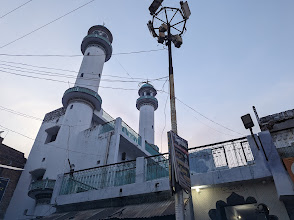
Masjid Sarwar is a modest local mosque nestled in the bustling Balkhandi Naka locality of Banda, Uttar Pradesh, serving as a serene spiritual hub for the Muslim community amid the city's historic Bundelkhand landscape. Constructed with simple yet enduring architecture, it reflects the everyday Islamic heritage of the region, offering a space for daily prayers and communal gatherings.
Tucked away in the vibrant heart of Balkhandi Naka—a bustling junction in Banda, the administrative seat of Uttar Pradesh's Bundelkhand region—Masjid Sarwar stands as a quiet testament to the enduring Islamic traditions woven into the fabric of small-town India. This unassuming mosque, named possibly in honor of a local benefactor or spiritual figure, embodies the understated elegance of vernacular Islamic architecture, where functionality meets quiet devotion without the grandeur of larger imperial monuments. Banda itself traces its roots to ancient times, with archaeological evidence of Paleolithic and Neolithic settlements underscoring its place in the cradle of early human civilization in northern India. The district's history unfolds through layers of Chandela Rajput rule in the medieval era, marked by formidable hill forts like Kalinjar, and later Mughal influences that left subtle imprints on the religious landscape. It was during the colonial and post-independence periods that local mosques like Sarwar emerged, catering to the needs of agrarian communities along the Ken River's banks. Though specific records of its founding are scarce—reflecting the oral and community-driven nature of such local sites—Masjid Sarwar likely dates to the mid-20th century, aligning with the post-Partition influx of Muslim families and the expansion of Banda's urban fringes. Architecturally, Masjid Sarwar eschews ornate domes or minarets, favoring a straightforward rectangular layout with whitewashed walls that blend seamlessly into the surrounding residential and commercial bustle. Its prayer hall, oriented toward the qibla, accommodates modest congregations for the five daily salah, with an ablution area at the rear ensuring ritual purity. The mihrab, a simple arched niche, serves as the focal point, while arched openings along the facade allow natural light to filter in, casting a soft glow during evening taraweeh prayers. Flanked by narrow alleys lined with modest homes and small shops, the mosque's courtyard—paved in weathered stone—doubles as a community space for iftar during Ramadan or informal discussions on faith and local affairs. In a district where grander sites like the Shahi Masjid within Kalinjar Fort evoke Mughal-era splendor, Masjid Sarwar's significance lies in its role as a living archive of everyday piety. It has weathered the socio-political shifts of independent India, including a reported incident in 2023 when an under-construction extension nearby faced vandalism by local groups alleging encroachments—a stark reminder of the tensions that occasionally shadow religious sites in the region. Yet, it persists as a symbol of resilience, fostering interfaith harmony in Balkhandi's diverse mosaic of Hindu temples, such as the nearby Bamdeveshwar Mandir, and Sikh gurdwaras. For visitors tracing India's Islamic heritage beyond the iconic Taj Mahal or Delhi's Jama Masjid, Masjid Sarwar offers an intimate glimpse into the grassroots expressions of faith. Accessible via National Highway 76 and the Banda Railway Station just a short distance away, it invites quiet reflection on how mosques, large and small, continue to anchor communities in the rhythmic flow of prayer and passage of time. In the shadow of the Yamuna's distant bend and the Ken's meandering course, this local gem quietly upholds the threads of history, devotion, and daily life that define Banda's soul.
Year of Built: Not Available
Address: F89J+WM7, Kotwali - Banyota Rd, Balkhandi Naka, Banda, Uttar Pradesh 210001
Country: India
State: Uttar Pradesh
District: Banda
Pincode: 210001
Longitude: 80.3362° E
Latitude: 25.4922° N