
Indo Islamic Heritage


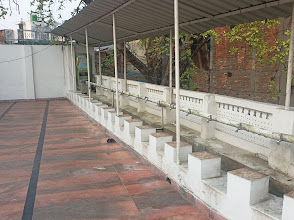
Shahi Masjid stands as a serene testament to Awadh's Nawabi architectural legacy in the heart of Begumganj, a locality named after its royal patroness. Constructed by Taqaiyya Begum, wife of a prominent Nawab of Awadh, this elegant mosque exemplifies the refined Indo-Islamic style of the period, blending Mughal grandeur with local craftsmanship. Its graceful domes, intricate stucco work, and tranquil courtyard continue to serve as a vital center for prayer and community reflection in Barabanki.
Nestled in the verdant landscape of Barabanki district, where the Ghaghara and Gomti rivers carve gentle boundaries through the Awadh plains, Shahi Masjid emerges as a poignant emblem of Islamic architectural heritage from the twilight of Mughal influence. Built in the late 18th century during the opulent Nawabi era of Awadh, the mosque was commissioned by Taqaiyya Begum, the esteemed wife of a high-ranking Nawab in the princely state. This royal benefactress, known for her piety and patronage of religious endowments, selected the site in Begumganj—named in her honor—as a halting place on the vital route between Lucknow and Faizabad, ensuring it served both travelers and locals as a spiritual sanctuary. The mosque's construction reflects the transitional aesthetics of Awadh's architecture, harmonizing the monumental scale of Mughal prototypes with the delicate, almost poetic flourishes characteristic of the region's Nawabi courts. Rising modestly yet imposingly from its plinth, the structure features a central prayer hall flanked by symmetrical wings, crowned by three onion-shaped domes that pierce the skyline with understated elegance. These domes, supported by robust octagonal piers and slender minarets at the corners, are adorned with subtle chhatris (pavilioned kiosks) that evoke the imperial mosques of Delhi and Agra, yet tempered by Awadh's preference for softer curves and lighter silhouettes. Entering through the arched eastern portal, one steps into a spacious courtyard paved with weathered bricks, enclosed by arcaded galleries that provide shaded verandas for the faithful. The mihrab, the qibla wall's focal point, is a masterpiece of intricate stucco arabesques and floral motifs, executed with the finesse of local artisans who drew inspiration from Persianate designs filtered through Lucknow's ateliers. Flanking it are arched niches and panels etched with geometric patterns, their surfaces once vibrant with lime wash and subtle gilding—remnants of which hint at the mosque's original splendor. The walls, constructed from locally sourced bricks and faced with lime plaster, bear faint traces of calligraphic inscriptions invoking divine blessings, underscoring the mosque's role as a conduit for devotion. As one of Barabanki's oldest surviving mosques, Shahi Masjid not only anchors the Shia Muslim community in Begumganj but also embodies the syncretic spirit of Awadh, where Hindu and Muslim architectural idioms subtly intertwined. Taqaiyya Begum's vision extended beyond mere construction; the mosque was integral to a larger complex that included an Imambara nearby, fostering gatherings for Muharram observances and scholarly discourse. Though time and the elements have softened its edges—requiring periodic restorations to preserve the domes and plasterwork—the structure retains its aura of quiet majesty, drawing worshippers who trace their rituals back to the Nawabs' era. In the broader tapestry of India's Islamic historical sites, Shahi Masjid occupies a humble yet significant niche, illustrating how regional potentates sustained Mughal traditions amid political flux. Its endurance through colonial transitions and modern upheavals speaks to the resilience of communal faith, making it a compelling destination for those seeking to unravel Awadh's layered past. Today, amid the hum of Barabanki's daily life, the mosque's call to prayer echoes as a timeless invocation, bridging centuries of devotion in this unassuming corner of Uttar Pradesh.
Year of Built: Not Available
Address: W5HR+69V, Begum Gunj, Barabanki, Uttar Pradesh 225001
Country: India
State: Uttar Pradesh
District: Barabanki
Pincode: 225001
Longitude: 81.1907° E
Latitude: 26.9279° N