
Indo Islamic Heritage


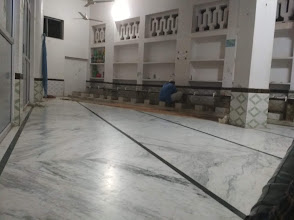
Nestled in the quiet village of Faizulla Ganj, just east of Barabanki town in Uttar Pradesh, Masjid-e-Faizullanganj stands as a modest yet enduring testament to the region's Islamic heritage. This local mosque, with its simple yet elegant design, serves as a serene place of worship for the surrounding community, embodying the spiritual tranquility of rural Awadh.
Masjid-e-Faizullanganj, often simply referred to as Faizulla Ganj Masjid, occupies a central role in the daily spiritual life of Faizulla Ganj village, a small settlement in the Banki Block of Barabanki District. Located approximately 2 kilometers east of Barabanki's district headquarters and 32 kilometers from the state capital, Lucknow, the mosque is enveloped by the lush, fertile landscapes of the Awadh region, where the Ghaghara and Gomti rivers have long shaped both agriculture and cultural exchange. Its coordinates at 26.9378° N, 81.2057° E place it within the heart of this historic corridor, an area renowned for its blend of Hindu and Muslim architectural legacies dating back to medieval times. Though precise records of its construction remain elusive in documented histories, the mosque's style aligns with the vernacular Islamic architecture prevalent in 19th-century Uttar Pradesh, particularly under the Nawabi rulers of Awadh. This era, marked by patronage from figures like the Nawabs of Lucknow, saw the proliferation of community mosques that emphasized functionality over grandeur—hallmarks evident in Masjid-e-Faizullanganj's unadorned yet harmonious form. The structure likely emerged during a period of relative stability in the region, following the consolidation of Awadh as a semi-autonomous princely state in the early 1800s, when local taluqdars and merchants funded such edifices to foster communal bonds. Barabanki itself, with its ancient roots as a penance ground for saints and ascetics, provided fertile soil for such developments, as the district's position between 26°30' and 27°19' N latitude and 80°05' to 81°51' E longitude made it a crossroads for pilgrims and traders alike. Architecturally, the mosque exemplifies the subdued elegance of local Indo-Islamic design, adapted to the agrarian rhythms of rural Uttar Pradesh. Its prayer hall, oriented toward the qibla, features a flat roof supported by sturdy brick pillars, with minimal ornamentation that prioritizes acoustic resonance for congregational prayers. The mihrab, a niche indicating the direction of Mecca, is carved with subtle geometric motifs, a nod to the Islamic prohibition on figurative art while evoking the intricate jaali screens found in more opulent Awadhi mosques. Flanking the entrance is a modest minaret, used traditionally for the adhan call to prayer, which echoes across the village fields at dawn and dusk. The surrounding courtyard, though compact, includes a small ablution area (wudu khana) fed by a hand pump, underscoring the mosque's practical role in community hygiene and ritual purity. As a local mosque, Masjid-e-Faizullanganj has quietly anchored the Muslim population of Faizulla Ganj, a village whose name honors a historical benefactor—possibly a local notable named Faizulla, whose legacy persists in the area's toponymy. It hosts the five daily salah, Jumu'ah congregational prayers on Fridays, and occasional religious gatherings during Ramadan and Eid, drawing residents from nearby hamlets. Unlike grander Mughal-era monuments such as the Babri Masjid in Ayodhya or the Shahi Jama Masjid in Sambhal, this edifice eschews imperial scale for intimate devotion, reflecting the decentralized nature of Islamic practice in 19th- and 20th-century rural India. Its endurance through colonial transitions, the 1857 Rebellion—which saw Barabanki taluqdars align with mutineers—and post-independence land reforms speaks to its role as a stable spiritual refuge amid flux.
Year of Built: Not Available
Address: W6P4+V86, Unnamed Road, Faizulla Ganj, Barabanki, Uttar Pradesh 225001
Country: India
State: Uttar Pradesh
District: Barabanki
Pincode: 225001
Longitude: 81.2057° E
Latitude: 26.9378° N