
Indo Islamic Heritage


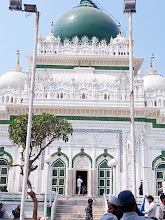
Dewa Sharif Dargah, a revered Sufi shrine in Uttar Pradesh, honors Haji Waris Ali Shah (1817–1905), the founder of the Warsi Sufi order. Nestled in the historic town of Dewa, it exemplifies communal harmony through its blended Indo-Persian architecture and interfaith contributions.
Perched in the verdant heart of Awadh, just 12 kilometers from Barabanki and 42 kilometers northeast of Lucknow, Dewa Sharif Dargah stands as a luminous testament to the syncretic spirit of 19th-century Indian Sufism. This sacred complex, dedicated to the memory of the esteemed Sufi saint Haji Waris Ali Shah, transcends mere architecture to embody a philosophy of universal love and interfaith unity. Born in 1817 into a family of Husaini Syeds in Dewa itself, Waris Ali Shah emerged as a pivotal figure in the spiritual landscape of colonial India. Orphaned young after his father Syed Qurban Ali Shah's passing, he imbibed the esoteric teachings of the Qadiri-Shattari order, embarking on extensive pilgrimages across India, Arabia, and Persia. By 1853, he had settled permanently in Dewa, where his khanqah (spiritual hospice) became a beacon for seekers from all walks of life, drawing Hindus and Muslims alike to his discourses on Vedantic and Sufi mysticism. Waris Ali Shah's life was marked by an unwavering commitment to humanism, famously encapsulated in his dictum: "All humanity is one family." His teachings emphasized transcending sectarian divides, fostering a milieu where rituals like Holi were celebrated with fervor at his abode—a tradition that persists uniquely at the dargah today as "Eid-e-Gulabi," where devotees shower flower petals and gulal in ecstatic remembrance. Upon his demise on April 7, 1905, following a brief illness, he was interred at the very spot of his khanqah, a simple grave that soon evolved into the grand mausoleum we witness today. The shrine's construction, commencing with its foundation stone laid in 1917 by Babu Kanhaiya Lal Srivastava—the inaugural Hindu secretary of the managing trust—reflected this ethos of collaboration from its inception. The dargah's architecture masterfully fuses Indo-Persian and Hindu elements, creating a harmonious visual narrative of cultural confluence. At its core is a resplendent white mausoleum crowned by a verdant dome, symbolizing eternal renewal. Flanking it are two intricately adorned shrines: one for Waris Ali Shah and another for his father, Qurban Ali Shah. Soaring minarets and towers evoke the grandeur of Persian design, while latticed outer chambers facilitate the Hindu-inspired parikrama (circumambulation), allowing devotees to encircle the sanctum in meditative devotion. The complex's silver-plated spire was a gift from Raja Udit Narain Singh of Gondal, the doorways clad in silver by the rulers of Kashmir, and the marble flooring funded by Thakur Pancham Singh of Mainpuri—a close Hindu confidant of the saint. These contributions underscore the shrine's role as a collaborative endeavor, overseen not by hereditary custodians but by a secular trust ensuring equitable access. Annually, the dargah pulses with life during the Urs observance in the Islamic month of Safar (typically July), commemorating Waris Ali Shah's union with the divine, and a second Urs for his father in Kartik (October-November), coinciding with the vibrant Dewa Mela fair. Pilgrims converge from across India and beyond, partaking in qawwali recitals, poetic mushairas, and spiritual discourses that echo the saint's legacy of inclusivity. As a cornerstone of Uttar Pradesh's Heritage Arc, Dewa Sharif Dargah not only preserves the tangible remnants of Awadh's Sufi heritage but also perpetuates an intangible bridge between faiths, inviting all to partake in its timeless embrace of shared humanity.
Year of Built: Not Available
Address: 25H9+P62, Dewa, Uttar Pradesh 225301
Country: India
State: Uttar Pradesh
District: Barabanki
Pincode: 225302
Longitude: 81.1700° E
Latitude: 27.0303° N