
Indo Islamic Heritage


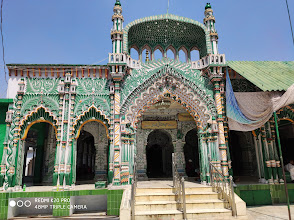
Nestled in the verdant landscapes of Barabanki district, the Dargah of Hazrat Sayyad Shah Abdul Razzaq Al Basvi Qadri (R.A.), revered as Sarkar-e-Bansa, stands as a timeless beacon of Sufi spirituality in Bansa Sharif, Uttar Pradesh. This 18th-century shrine, enshrining the tomb of the illustrious Qadri saint who passed away in 1725, embodies the ethos of universal love and harmony, drawing devotees from all walks of life to its serene khanqah for solace and blessings.
In the heart of Uttar Pradesh's Barabanki district, where the gentle undulations of the Gangetic plain meet the whispers of ancient spiritual legacies, lies Bansa Sharif—a modest village transformed into a sacred haven by the enduring presence of the Dargah of Hazrat Sayyad Shah Abdul Razzaq Al Basvi Qadri (R.A.). Known affectionately as Sarkar-e-Bansa or Syed Sahab, this shrine is not merely a architectural relic but a living testament to the syncretic Sufi traditions that have woven the fabric of India's Islamic heritage for over three centuries. Situated 18 kilometers east of Barabanki city, 4 kilometers from Masauli, and 48 kilometers from the bustling capital of Lucknow, the dargah occupies a pivotal place in the spiritual geography of Awadh, serving as a khanqah (spiritual hospice) that echoes the timeless call for unity amid diversity. The origins of this revered site trace back to the saint himself, Hazrat Shah Abdul Razzaq Al Basvi Qadri, whose life bridged the opulent Mughal era and the profound mysticism of the Qadri silsila (order). Born in the 1630s during the reign of Emperor Shah Jahan—a period marked by architectural grandeur and cultural efflorescence—Syed Sahab hailed from a lineage of Syeds who had migrated from the Badakshan Valley in Central Asia to Delhi via Multan in the time of Babur. Though an 'ummi' (unlettered in the formal sense), he was divinely endowed with profound spiritual insight, earning him the title of a born wali (friend of God). His early years were spent in worldly pursuits, including service as a security guard, reflecting the martial ethos of the time, but at the age of 53, around the late 1680s, he renounced material life to found the khanqah in his native Bansa. This institution became a cradle for disseminating the Sufi ideals of truth, peace, love, and harmony, open to all irrespective of caste, creed, or faith, embodying the motto "Love towards all, malice towards none"—a direct inspiration from the 12th-century Sultan-ul-Hind, Khwaja Moinuddin Chishti of Ajmer. Hazrat Shah Abdul Razzaq's spiritual pedigree further elevates the dargah's sanctity. As a devoted disciple of the eminent Sufi master Shah Dost Mohammad (Shah Dosi Lakhnavi), he was immersed in the Razzaqiyah branch of the Qadriyah order, tracing his silsila through luminous figures such as Sultan-ul-Hind Khwaja Gharib Nawaz, Nizamuddin Auliya, and Zinda Shah Madar. His interactions with contemporary luminaries, including the ulema of Firangi Mahal, Fazlur Rehman Ganj Moradabadi, Qazi Dahlan Makki, Mawlana Abdur Rahman Lucknawi, Haji Waris Ali Shah of Dewa Sharif, Iftikharul Haq Qadri, Baba Tajuddin of Nagpur, and the poet Hasrat Mohani, underscore his role as a bridge between esoteric mysticism and scholarly discourse. These associations not only enriched the khanqah's intellectual milieu but also amplified its influence across the subcontinent, fostering a network of spiritual succor that transcended sectarian boundaries. The dargah itself, constructed shortly after the saint's wafat (demise) in 1724-25 at the venerable age of 90, during the twilight of Mughal dominion under Emperor Muhammad Shah, encapsulates the understated elegance of Awadhi Islamic architecture. Though exact construction records remain elusive—typical of many Sufi shrines built organically by devotees—the mausoleum was raised over his grave as an immediate homage, integrating seamlessly with the earlier khanqah. The complex features a simple yet evocative dome-crowned tomb, adorned with intricate chini-kari (tile work) and calligraphy invoking divine attributes, surrounded by arched verandas that invite quiet reflection. Flanked by a mosque for congregational prayers and modest living quarters for the sajjada nashin (hereditary custodians from the saint's progeny), the site pulses with rhythmic qawwali sessions, langar (communal feasts), and milads during the annual urs (death anniversary) celebrations, which draw thousands in a vibrant tapestry of devotion. Today, Bansa Sharif endures as a sanctuary of interfaith amity, its spiritual effulgence undimmed after nearly 300 years. Devotees, from rural pilgrims to urban seekers, converge here weekly and monthly, attributing miracles of healing and guidance to the saint's karamat (spiritual graces). Managed by descendants who perpetuate the khanqah's mission of aiding the marginalized, the dargah stands as a poignant reminder of Sufism's role in nurturing India's pluralistic soul—much like its contemporaries in Ajmer, Nizamuddin, or Dewa Sharif—where stone and spirit converge to heal the divides of the human heart. In an age of fragmentation, Sarkar-e-Bansa whispers an eternal invitation: to pause, to pray, and to partake in the boundless mercy that knows no borders.
Year of Built: Not Available
Address: X87X+86G, Bansa, Uttar Pradesh 225412
Country: India
State: Uttar Pradesh
District: Barabanki
Pincode: 225212
Longitude: 81.29355° E
Latitude: 26.99445° N