
Indo Islamic Heritage


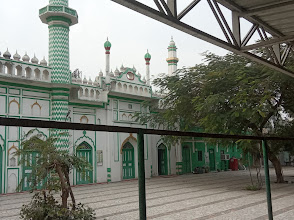
Noumahla Masjid, a revered 18th-century mosque in Bareilly's Civil Lines, embodies the architectural and spiritual legacy of Rohilkhand's Islamic heritage. Established amid the Rohilla Kingdom's zenith, it stands as a poignant symbol of communal resilience, having served as a clandestine hub for revolutionaries during the 1857 Indian Rebellion. Its enduring minarets and prayer halls continue to draw devotees, offering a serene space for reflection on faith and history.
Nestled in the heart of Bareilly's Civil Lines, Noumahla Masjid (Urdu: نو محلہ مسجد) emerges as a timeless testament to the syncretic cultural tapestry of Uttar Pradesh's Rohilkhand region. Founded in 1749 during the flourishing era of the Rohilla Kingdom, the mosque was commissioned by Nawab Hafiz Rahmat Khan Barech, a visionary Afghan-origin ruler whose patronage fortified Bareilly as a bastion of Islamic learning and governance. Rahmat Khan, renowned for his administrative acumen and military prowess, entrusted the initial structure to the scholarly Syed Shaji Baba, a Sufi mystic whose lineage infused the site with spiritual depth. This foundational phase marked the mosque not merely as a place of worship but as a communal anchor in a landscape shaped by Mughal decline and regional autonomy. The mosque's architecture, while rooted in 18th-century Indo-Islamic motifs, underwent a transformative reconstruction in 1906, yielding the robust concrete edifice that graces the skyline today. Its design harmonizes simplicity with subtle grandeur: slender minarets pierce the horizon, evoking the call to prayer that has echoed across generations, while the expansive prayer hall—adorned with intricate geometric jaali work and arched mihrabs—invites contemplation under vaulted ceilings. Flanked by modest courtyards, the structure reflects the pragmatic elegance of Rohilla-era builds, blending Persian influences with local craftsmanship. Though not as opulent as Delhi's imperial mosques, Noumahla's understated beauty lies in its lived authenticity, its walls whispering tales of daily devotion and quiet endurance. Beyond its aesthetic allure, Noumahla Masjid holds profound historical resonance as a witness to India's quest for independence. During the tumultuous 1857 Revolt—when Bareilly became a fiery epicenter of resistance against British colonial rule—the mosque transformed into a clandestine nerve center for revolutionaries. Under the shadow of its minarets, local leaders and sepoys orchestrated strategies, sheltered fugitives, and rallied the faithful against the East India Company's grip. Bareilly's uprising, led by figures like Khan Bahadur Khan, briefly liberated the city, with Noumahla serving as a sanctuary where faith fueled defiance. This revolutionary legacy elevates the mosque beyond religious confines, positioning it as a hallowed site of national memory, where the clamor of rebellion once mingled with the solemnity of salah. Today, Noumahla Masjid remains a vibrant focal point for Bareilly's Muslim community, hosting daily prayers, Ramadan iftars, and scholarly gatherings that honor its Sufi origins. Its location in the verdant Civil Lines—once a colonial enclave—juxtaposes colonial echoes with indigenous resilience, underscoring Bareilly's evolution from a Rohilla stronghold to a modern urban hub. For pilgrims and historians alike, a visit to Noumahla offers more than architectural admiration; it is an invitation to trace the threads of faith, fortitude, and forgotten valor that have woven India's pluralistic past. In an age of rapid change, this modest mosque endures as a quiet guardian of heritage, its foundations as steadfast as the convictions that birthed it.
Year of Built: 18th Century
Address: 9C48+R4F, Civil Lines, Bareilly, Uttar Pradesh 243003
Country: India
State: Uttar Pradesh
District: Bareilly
Pincode: 243003
Longitude: 79.4200° E
Latitude: 28.3622° N