
Indo Islamic Heritage


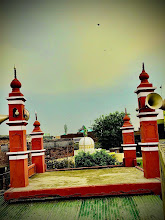
Lal Masjid, or the Red Mosque, stands as a modest yet enduring symbol of Islamic heritage in the village of Malookpur, near Bareilly in Uttar Pradesh. Named for its distinctive red-painted facade, this historic mosque serves as a central place of worship for the local Muslim community, reflecting the architectural simplicity and spiritual resilience of 19th-century Rohilkhand mosques. Its quiet courtyard and arched prayer hall offer a serene space for daily prayers, embodying the region's syncretic cultural legacy amid the fertile plains of the Ganges basin.
Nestled in the agrarian heartland of Rohilkhand, Lal Masjid in Malookpur emerges as a poignant testament to the enduring Islamic architectural tradition in northern India, where faith intertwined with the rhythms of rural life during the turbulent 19th century. Constructed amid the socio-political shifts of British colonial rule, the mosque's origins trace back to a period when Muslim communities in Uttar Pradesh sought to preserve their religious identity through modest yet functional places of worship. Though precise records of its founding remain scarce—attributable to the era's limited documentation for rural structures—it is widely acknowledged as a product of the mid-to-late 1800s, a time when local nawabs and merchants patronized such builds to foster communal solidarity in the wake of the 1857 Revolt. The mosque's nomenclature, "Lal Masjid," derives directly from its signature red ochre exterior, a practical choice of lime-based paint derived from local pigments that not only provided protection against the region's humid monsoons but also evoked the vibrant aesthetics of Mughal-era influences lingering in provincial designs. Architecturally, it adheres to the unadorned Indo-Islamic style prevalent in smaller Uttar Pradesh mosques: a rectangular prayer hall oriented toward the qibla, flanked by slender minarets that rise modestly to call the faithful to prayer. The central mihrab, carved with simple geometric motifs in stucco, draws the eye inward, while the surrounding courtyard—enclosed by low walls—serves as a communal ablution area, fostering the egalitarian spirit of Islamic congregational life. Unlike grand urban counterparts such as Delhi's Jama Masjid, Lal Masjid's scale mirrors its rural context, spanning roughly 1,000 square feet and accommodating up to 200 worshippers during peak times like Eid. Historically, the mosque's significance lies in its role as a steadfast anchor for Malookpur's Muslim populace, a village that has long been part of Bareilly's tehsil fabric since the district's formal delineation in 1801. Bareilly itself, once a stronghold of Rohilla Afghan chieftains in the 18th century, witnessed waves of Islamic settlement that blended Pashtun, Persian, and Awadhi influences; Lal Masjid quietly perpetuated this legacy by hosting not just namaz but also milads and Quranic recitations, sustaining oral traditions of Sufi poetry amid the encroaching colonial administrative order. Its survival through partitions, migrations, and modern urban sprawl underscores the resilience of such sites, which often escaped the fate of more prominent monuments due to their peripheral location—approximately 10 kilometers from Bareilly's bustling core. Today, Lal Masjid remains an active beacon of devotion, its red walls a vivid counterpoint to the surrounding mustard fields and sugarcane groves. For historians and travelers tracing Uttar Pradesh's Islamic tapestry, it offers a humble portal into the subcontinent's layered past, where architecture speaks volumes in its restraint. Visitors are drawn not to opulent domes or intricate jalis, but to the mosque's unpretentious authenticity—a reminder that India's sacred spaces thrive as much in whispered adhan as in imperial grandeur. As the sun sets over the Ramganga River nearby, the mosque's silhouette evokes a timeless serenity, inviting reflection on faith's quiet persistence in the face of time's inexorable flow.
Year of Built: Not Available
Address: Malookpur lal masjid, Uttar Pradesh 243003
Country: India
State: Uttar Pradesh
District: Bareilly
Pincode: 243003
Longitude: 79.2500° E
Latitude: 28.3800° N