
Indo Islamic Heritage


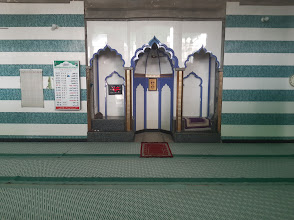
Nestled in the bustling Rajendra Nagar locality of Bareilly, Bagh Wali Masjid stands as a modest yet enduring testament to the city's syncretic Islamic heritage. This early 20th-century mosque, with its simple brick-and-plaster facade and serene prayer hall, serves as a vital community hub for local Muslims. Enclosed within a quiet compound evoking the "bagh" (garden) of its name, it reflects the understated elegance of Rohilkhand's vernacular mosque architecture, blending Mughal influences with local craftsmanship. Though unassuming compared to Bareilly's grander shrines, it remains a peaceful sanctuary for daily prayers and quiet reflection amid urban growth.
Bareilly, in the heart of Uttar Pradesh's Rohilkhand region, has long been a cradle of Islamic scholarship and architecture, from the 19th-century Bareilly Sharif Dargah honoring Ahmed Raza Khan Barelvi to the scattered mosques dotting its colonial-era neighborhoods. Among these, Bagh Wali Masjid in Rajendra Nagar emerges as a poignant example of localized Islamic devotion, rooted in the early 20th century—a period when British colonial rule intersected with resurgent Muslim community life in northern India. Constructed around the 1920s, during the waning years of the British Raj, the mosque's origins align with a wave of modest religious constructions by local Muslim patrons seeking to affirm their cultural identity amid socio-political flux. While precise founding records are scarce—typical for smaller community-built structures—its architectural style mirrors that of contemporaneous mosques in Bareilly, such as those influenced by the lingering Mughal aesthetic adapted to regional resources. The name "Bagh Wali," meaning "of the garden," alludes to its original enclosure, a small verdant courtyard that once buffered the prayer space from the surrounding bustle, fostering an oasis-like tranquility now partially absorbed by Rajendra Nagar's residential sprawl. The mosque's design embodies practical piety over ostentatious grandeur. Its facade, rendered in red brick with lime plaster accents, features a central arched mihrab portal flanked by narrower side entrances, allowing natural light to filter into the rectangular prayer hall. Inside, the space unfolds simply: a hypostyle arrangement supported by slender columns, topped by flat-roofed bays rather than elaborate domes, which suits Bareilly's subtropical climate and seismic considerations. The qibla wall, oriented precisely toward Mecca, bears subtle geometric stucco motifs—interlocking stars and vines—evocative of Indo-Islamic motifs but executed in local idiom, without the ornate pietra dura of imperial monuments. Adjoining the main hall is a modest minaret-like turret, once used for the adhan call to prayer, now integrated into the compound wall for structural stability. Historically, Bagh Wali Masjid has served as more than a place of worship; it anchored the social fabric of Rajendra Nagar, a locality named after India's first Prime Minister, Jawaharlal Nehru, and developed in the post-independence era but with roots in pre-Partition Muslim settlements. During the 1947 Partition riots that rippled through Uttar Pradesh, such neighborhood mosques provided refuge and continuity for displaced families, preserving oral traditions of faith amid upheaval. By the mid-20th century, as Bareilly industrialized, the mosque adapted quietly—adding basic ablution facilities and electric lighting—while maintaining its role in community iftars during Ramadan and modest Eid congregations.
Year of Built: Not Available
Address: 9CMM+R9P, N H 74, Rajendra Nagar, Bareilly, Uttar Pradesh 243122
Country: India
State: Uttar Pradesh
District: Bareilly
Pincode: 243122
Longitude: 79.4304° E
Latitude: 28.3670° N