
Indo Islamic Heritage


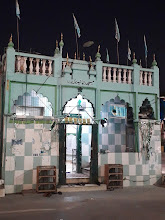
Nestled at the bustling Chowki Chauraha crossroads in Bareilly's Civil Lines, Chowki Chauraha Masjid stands as a modest yet enduring testament to the city's Islamic heritage. This compact mosque, with its simple arched facades and central dome, serves as a vital prayer space for locals and travelers alike, evoking the resilient spirit of Rohilkhand's Muslim community amid the colonial landscape of northern India.
In the heart of Bareilly, a city long revered as a cradle of Islamic scholarship and Sufi traditions in Uttar Pradesh's Rohilkhand region, Chowki Chauraha Masjid emerges as a understated architectural gem reflective of 19th-century Indo-Islamic design. Situated prominently at the intersection of Lal Fatak Road and key arterial routes in the Civil Lines area—a neighborhood shaped by British colonial planning after the 1857 Indian Revolt—the mosque occupies a strategic vantage point that has historically facilitated communal gatherings and daily worship. Its location at the eponymous "Chowki Chauraha" (outpost crossroads), named for the adjacent police outpost, underscores its role as a navigational and spiritual anchor in one of Bareilly's most vibrant commercial hubs. Constructed in the late 19th century, around the 1880s, the masjid was erected during a period of transition when the Rohilkhand region's Muslim populace sought to reaffirm their cultural and religious identity under British rule. Bareilly, once a stronghold of the Rohilla Nawabs until their defeat in 1774, had by this era become a mosaic of Mughal remnants and colonial influences. While grander structures like the nearby Ala Hazrat Dargah (the shrine of Ahmed Raza Khan Barelvi, founded in 1876) dominated the spiritual skyline, Chowki Chauraha Masjid embodied a more utilitarian ethos—built not as an imperial monument but as an accessible sanctuary for the working-class faithful. Local chronicles and oral histories preserved among Bareilly's ulema suggest it was commissioned by local Muslim philanthropists responding to the post-Revolt demographic shifts, when Civil Lines was developed to house administrative offices and a growing urban Muslim population displaced from older quarters. Architecturally, the mosque adheres to the understated Mughal-derived style prevalent in provincial Uttar Pradesh mosques of the era. Its facade features gently pointed arches framing the mihrab, with a single modest dome crowning the prayer hall, constructed from locally sourced brick and lime mortar for durability in the region's humid subtropical climate. The minaret, slender and unadorned, rises modestly to call the adhan five times daily, blending seamlessly into the surrounding urban bustle. Inside, the prayer space accommodates around 200 worshippers, with clean white-washed walls inscribed with simple Quranic verses in elegant thuluth script—a nod to the calligraphic traditions of the nearby Barelvi school of thought. Facilities for wudu (ablution) are thoughtfully integrated, featuring functional fountains that have been maintained over generations, ensuring the mosque's practicality for hurried commuters and out-of-town pilgrims. Beyond its physical form, Chowki Chauraha Masjid holds profound historical resonance as a symbol of continuity amid upheaval. Bareilly's Islamic legacy traces back to the 12th century with the arrival of Sufi saints, but the 19th century brought challenges from colonial land reforms and the suppression of the 1857 uprising, in which local Muslims played a pivotal role. The masjid, positioned near the historic Lal Fatak (Red Gate), a remnant of the city's pre-colonial fortifications, quietly endured as a site for Jumu'ah (Friday) prayers that drew diverse congregations, fostering interfaith dialogues in a tense era. Today, it remains a living repository of this history, where elders recount tales of pre-independence imams who navigated British oversight while preserving rituals. Though not as ornate as Delhi's Jama Masjid or Lucknow's Asafi Imambara, its unpretentious charm lies in its everyday sanctity—hosting Taraweeh during Ramadan and serving as a respite for the faithful amid the chauraha's ceaseless traffic. As Bareilly evolves into a modern metropolis, Chowki Chauraha Masjid stands resilient, a quiet custodian of Rohilkhand's Islamic soul. Visitors to this historic site are drawn not by grandeur, but by the timeless echo of devotion that has reverberated from its minaret for over a century, inviting reflection on the enduring interplay of faith, community, and place in India's pluralistic tapestry.
Year of Built: Not Available
Address: 8CXC+838, Lal Fatak Rd, Civil Lines, Bareilly, Uttar Pradesh 243001
Country: India
State: Uttar Pradesh
District: Bareilly
Pincode: 243001
Longitude: 79.4202° E
Latitude: 28.3482° N