
Indo Islamic Heritage


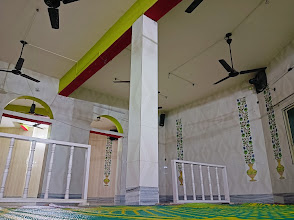
Madina Masjid stands as a modest yet vital center of worship in the heart of Ram Nagar Colony, a residential neighborhood in Bareilly, Uttar Pradesh. Named after the holy city of Medina, this contemporary mosque serves the local Muslim community with daily prayers, Friday congregations, and community gatherings, reflecting the enduring Islamic heritage of Rohilkhand amid modern urban life.
Nestled within the bustling residential fabric of Ram Nagar Colony in Bareilly—a city renowned as the cultural and administrative hub of the Rohilkhand region—Madina Masjid emerges as a serene emblem of faith and communal harmony. Bareilly itself traces its roots to the 16th century under Mughal patronage, evolving into a stronghold of Islamic scholarship and architecture during the Rohilla Nawabs' rule in the 18th century. Though Madina Masjid does not rank among the grand Mughal-era monuments like the nearby Ala Hazrat Dargah or the historic Jami Masjid of Bareilly (established in the 17th century), it embodies the continuity of Islamic traditions in post-colonial India, where local mosques became anchors for displaced communities post-Partition and amid rapid urbanization. Constructed in the latter half of the 20th century—aligned with the expansion of Ram Nagar Colony as a post-independence housing enclave for working-class families—the mosque's architecture adheres to simple Indo-Islamic principles. Its unassuming facade features a central dome topped with a crescent finial, flanked by two slender minarets that call the faithful to prayer five times a day. The prayer hall, oriented toward the qibla, accommodates around 200-300 worshippers during peak times, with white-washed walls adorned with subtle geometric motifs and verses from the Quran in elegant Arabic calligraphy. The mihrab, a niche marking the direction of Mecca, is crafted from local stone, evoking the humility and devotion central to Islamic practice. As a neighborhood institution, Madina Masjid transcends mere worship, fostering social cohesion in Ram Nagar Colony, a locality developed in the 1960s-1970s to house migrants and local laborers drawn to Bareilly's textile mills and railway workshops. Historical accounts of Bareilly's Islamic landscape highlight how such community mosques sustained religious life during turbulent periods, including the 1857 Revolt, when the city became a focal point of resistance against British rule. While specific annals of Madina Masjid's founding remain sparse—likely due to its recent origins and reliance on oral community histories—it has quietly upheld traditions like Ramzan iftars, Eid celebrations, and Quranic education classes, mirroring the resilience of Rohilkhand's Muslim populace. Today, at coordinates 28.367°N, 79.430°E, the mosque overlooks tree-lined lanes and modest homes, its pincode 243303 linking it to Bareilly's expansive postal network that serves over 3.6 million residents in the district. Visitors to this understated site will find not the opulence of imperial shrines but the quiet profundity of lived faith—a testament to how Islamic sacred spaces in India adapt and endure, weaving the threads of history into the everyday rhythm of prayer and fellowship. For those exploring Bareilly's Islamic tapestry, Madina Masjid offers a poignant reminder that true historical value lies in the spaces where communities gather to preserve their spiritual legacy.
Year of Built: Not Available
Address: 1612, 1612, Mahlaw Rd, Ram Nagar Colony, Bareilly, Uttar Pradesh 243122
Country: India
State: Uttar Pradesh
District: Bareilly
Pincode: 243122
Longitude: 79.430°E
Latitude: 28.367°N