
Indo Islamic Heritage


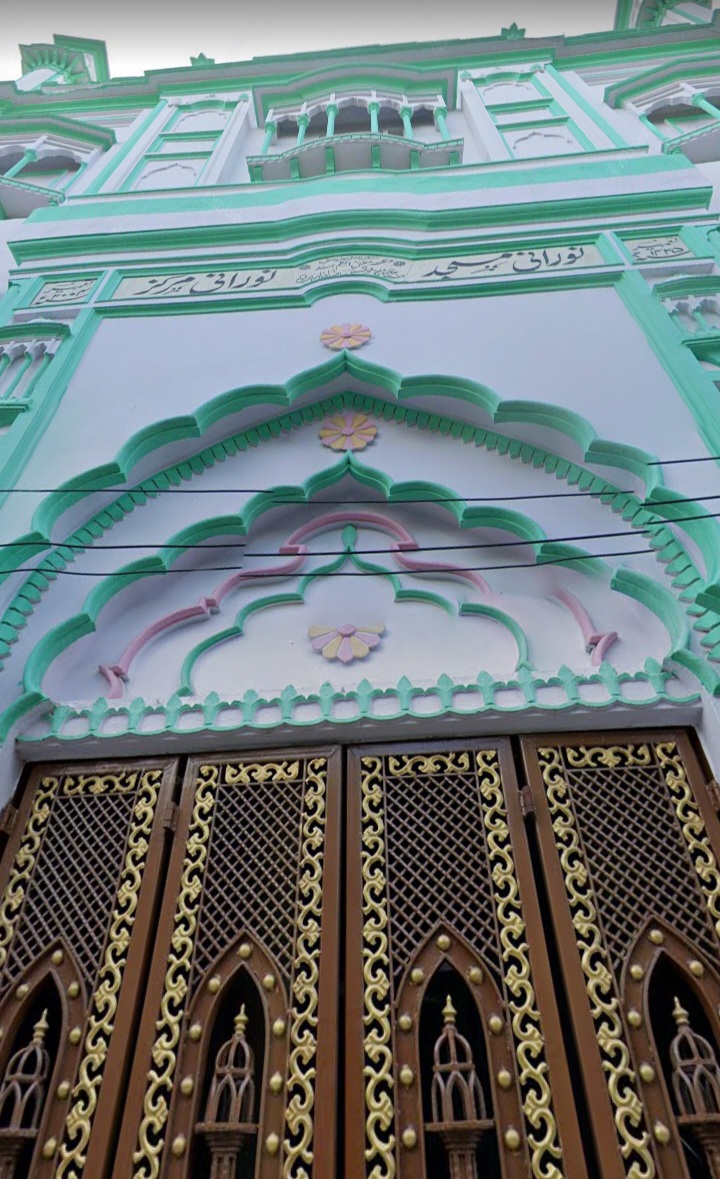
Noorani Masjid, a modest yet cherished local mosque nestled in the historic Old City of Bareilly, Uttar Pradesh, stands as a serene testament to the city's enduring Islamic heritage. Tucked within the bustling lanes of Sayyado Wali Sufi Tola, it serves as a vital community hub for daily prayers and spiritual reflection, embodying the simple architectural elegance typical of regional mosques from the Mughal and Rohilla eras.
In the heart of Bareilly's Old City—a labyrinth of narrow alleys echoing the footsteps of Mughal governors and Rohilla chieftains—lies Noorani Masjid, a quiet beacon of faith amid the vibrant tapestry of Uttar Pradesh's Rohilkhand region. Founded in 1657 by Mughal official Mukrand Rai as a strategic outpost east of the Ramganga River, Bareilly blossomed under the Rohilla Nawabs, Afghan migrants who infused the area with Persianate Islamic culture in the mid-18th century. It was during this era of prosperity and cultural synthesis that mosques like Noorani Masjid emerged, not as grand imperial monuments, but as intimate spaces for communal worship, reflecting the lived piety of local Muslim artisans, traders, and scholars. The mosque's name, "Noorani" (meaning "luminous" or "radiant" in Arabic), evokes the spiritual light it casts over its congregants, drawing from Sufi traditions that have long permeated Rohilkhand's Islamic ethos. Situated in Sayyado Wali Sufi Tola, a neighborhood resonant with the legacy of Sufi saints and sayyids (descendants of the Prophet Muhammad), Noorani Masjid occupies a modest footprint in Ram Vatika, a locality steeped in the area's pre-colonial history. Though precise construction documents remain elusive—likely due to its status as a community-built structure rather than a royal commission—its unadorned brick facade, arched mihrab (prayer niche), and subtle geometric motifs on the minarets align stylistically with mid-18th-century designs patronized by Rohilla leaders like Hafiz Rahmat Khan. This places its origins around the 1740s–1760s, a time when Bareilly served as the Rohillas' capital, fostering a network of neighborhood masjids that supported the growing Pashtun and local Muslim populations. Architecturally, Noorani Masjid exemplifies the pragmatic beauty of vernacular Islamic design in northern India. Its courtyard, though compact, opens to the sky for wudu (ablution) under the benevolent gaze of ancient neem trees, while the prayer hall accommodates rows of devotees with simple red sandstone flooring worn smooth by generations of prostrations. Flanking the entrance are twin minarets, slender and unpretentious, used traditionally for the azan (call to prayer) that reverberates through the tola's winding galis. Unlike the ornate chandeliers of imperial mosques, Noorani's interior relies on natural light filtering through latticed jali screens, creating patterns that dance across walls inscribed with Quranic verses in elegant Thuluth script. These elements underscore its role not as a tourist spectacle, but as a living sanctuary, where the fragrance of attar mingles with the murmur of surahs during taraweeh prayers in Ramadan. Historically, Noorani Masjid has weathered the tempests of Rohilkhand's turbulent past. The Rohilla War of 1774, when Nawab Shuja-ud-Daula of Awadh, aided by the British East India Company, overran the region, brought devastation to Bareilly's Muslim enclaves; yet, resilient structures like this mosque endured, symbolizing continuity amid conquest. By 1801, when the city was ceded fully to British rule, Noorani Masjid had already embedded itself in the social fabric of the Old City, serving as a refuge during the 1857 Revolt—when Bareilly briefly became a center of sepoy resistance—and the communal tensions of the early 20th century. Local oral histories recount how its imam mediated neighborhood disputes, fostering harmony in a diverse mohalla that included Hindu weavers and Muslim zardozi artisans, whose intricate embroidery still graces Bareilly's markets. Today, at coordinates 28.3622° N, 79.4200° E—precisely mapping to the Ramganga's eastern banks—Noorani Masjid remains a cornerstone of Bareilly's 243005 pincode area. Accessible via the labyrinthine paths from Bareilly Junction (just 3 km away), it draws locals for fajr at dawn and maghrib at dusk, its minarets silhouetted against the Uttar Pradesh skyline. In an era of rapid urbanization, this unassuming edifice preserves the essence of Rohilkhand's Islamic soul: humble, enduring, and luminous in its devotion. For those tracing India's layered past, Noorani Masjid offers not grandeur, but the profound intimacy of history etched in prayer.
Year of Built: Not Available
Address: 9C8J+8XX, kankar Tala, Old City, Bareilly, Uttar Pradesh 243005
Country: India
State: Uttar Pradesh
District: Bareilly
Pincode: 243005
Longitude: 79.4200° E
Latitude: 28.3622° N