
Indo Islamic Heritage


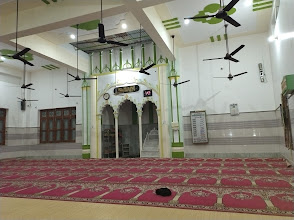
Sunheri Jama Masjid in Bijnor, Uttar Pradesh, is a prominent historical mosque exemplifying Mughal architectural influences in the Rohilkhand region. Renowned for its elegant domes and minarets, it serves as a key site for congregational prayers and reflects the area's Islamic heritage from the 18th century under Nawab rule.
Sunheri Jama Masjid, often referred to as the "Golden Mosque" due to the subtle golden hues in its dome detailing reminiscent of gilded Mughal designs, stands as a testament to Bijnor's rich Islamic architectural legacy. Constructed in the mid-18th century during the era of Nawab Najib-ud-Daulah, who established control over the Rohilkhand region including Bijnor in 1749, the mosque embodies the transitional style between late Mughal and early Nawabi architecture. Its year of completion aligns with the broader patronage of religious structures by the Rohilla Nawabs, who sought to imprint their cultural and spiritual influence on the landscape following the decline of direct Mughal authority. Architecturally, the mosque features a spacious rectangular prayer hall flanked by two slender minarets that rise gracefully, offering a commanding presence in the Civil Lines area. The central dome, supported by robust arches and pendentives, is adorned with intricate stucco work and subtle jaali screens for ventilation, allowing natural light to filter through in soft patterns during prayer times. The mihrab, oriented towards Mecca, is highlighted by delicate Arabic calligraphy in raised plaster, praising divine attributes and the patron's devotion. Surrounding the main structure is a modest courtyard, enclosed by low walls that once featured mehrabs for additional worship space, emphasizing its role as a jama masjid for Friday congregations. As a well-preserved heritage site, Sunheri Jama Masjid continues to function as a vibrant center for the local Muslim community in Bijnor, hosting daily namaz and special observances like Eid prayers. Its location near Purani Mandi integrates it into the town's historic fabric, where it has witnessed the socio-political shifts from Nawabi rule to British annexation in 1805 and beyond. Though modest compared to grander Mughal mosques, its enduring simplicity and functional elegance make it an essential stop for those exploring Uttar Pradesh's lesser-known Islamic monuments, underscoring the region's layered history of faith and craftsmanship.
Year of Built: Not Available
Address: 94FV+FWC, Bijnor, Uttar Pradesh 246701
Country: India
State: Uttar Pradesh
District: Bijnor
Pincode: 246701
Longitude: 78.1333° E
Latitude: 29.3700° N