
Indo Islamic Heritage


_-_2025-01-05T142318_760.jpeg)
_-_2025-01-05T142307_778.jpeg)
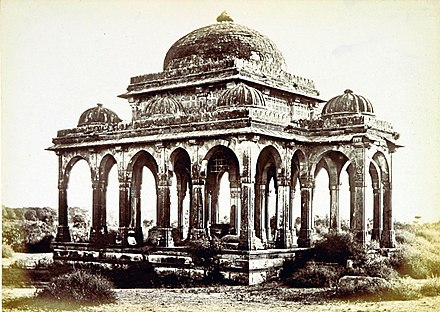
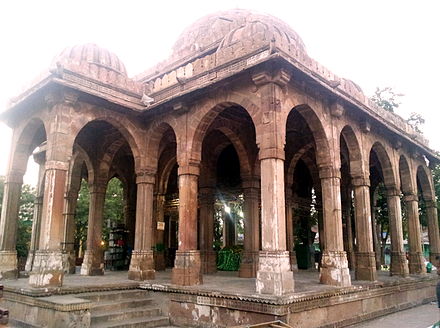
Mir Abu Turab's Tomb, locally referred to as Qadam-e-Rasul ki Dargah, is a significant medieval architectural monument situated in the Behrampura area of Ahmedabad, India. This historic tomb holds immense cultural and religious importance, being associated with Mir Abu Turab.
Mir Abu Turāb al-Uraizi hailed from a distinguished lineage of Salami Saiyids from Shiraz and was a follower of the Saisalah-i-Maghrabiyah. His grandfather, Saiyid Shah Mir, a prominent scholar, had settled in Muhammadabad (Champaner) during the reign of Sultan Mahmud Begada. Abu Turāb rose to prominence as a notable figure in Gujarat?s history, beginning with his role as an intermediary between Itimad Khan, the then Governor of Gujarat, and Emperor Akbar. Itimad Khan sought Akbar?s intervention to annex Gujarat, a pivotal moment that marked Akbar's 1572 invasion. During this campaign, Mir Abu Turāb, along with other nobles, pledged allegiance to Akbar, paying homage to the Mughal emperor. While many nobles revolted after Akbar left Ahmedabad, Abu Turāb remained steadfast in his loyalty, showcasing his integrity and commitment to the Mughal ruler. Under Akbar?s reign, Mir Abu Turāb served as the chief of the army in Gujarat, holding significant influence. In 1579, he was appointed chief of the Mecca caravan, a prestigious position that involved overseeing the pilgrimage. During this tenure, in 1582 (987 H.), he brought back a revered relic from Mecca?a large stone bearing the footprint of the Prophet Mohammed. This stone was historically significant, as it was believed to have been brought to Delhi by Syed Jalal-i-Bukhari during Sultan Firuz Shah Tughlaq's era. Initially taken to Akbar at Fatehpur Sikri, the emperor regarded the relic with skepticism, deeming it a pious fraud. However, out of respect, Akbar allowed Abu Turāb to retain the stone in his house. Later, in 1583, when Itimad Khan was appointed Governor of Gujarat, Abu Turāb followed him as the Amin of the Suba. Abu Turāb?s contributions extended beyond his administrative and military roles; he was also a scholar and historian, authoring the Tarikh-i-Gujarat, a comprehensive account of Gujarat?s history. He passed away in 1597 (1005 H) and was buried in Ahmedabad. His tomb became a revered site, attracting pilgrims who came to venerate the relic, which was eventually moved within the city walls for safety during the tumultuous 18th century. Architecturally, Mir Abu Turāb?s tomb is a testament to the local artistry of the period. It features a simple yet elegant design, with a square platform measuring 12.5 square meters (forty-one feet). The structure is adorned with a double colonnade of pillars, and its inner colonnade was once enclosed by intricate stone trellis work. The use of arches instead of flat lintels lends the tomb a harmonious and uniform appearance. Each face of the tomb features three large and two smaller arches, indicating the presence of an octagonal dome supported by twelve pillars. The absence of ornate minaret bases enhances the structure's understated elegance, making it a striking example of the region's architectural finesse. Though the tomb suffered damage during the 2001 Gujarat earthquake, it was restored by the Archaeological Survey of India in 2002, preserving its historical and cultural significance for future generations.
Year of Built: 16th Century
Address: 17-18, Khodiyar Nagar Rd, Calico Mills, Behrampura, Ahmedabad, Gujarat
Country: India
State: Gujarat
District: Ahmedabad
Pincode: 380022
Longitude: 72.576626
Latitude: 23.004656