
Indo Islamic Heritage


_-_2025-01-05T151141_538.jpeg)
_-_2025-01-05T151137_128.jpeg)
_-_2025-01-05T151132_959.jpeg)
_-_2025-01-05T151126_416.jpeg)
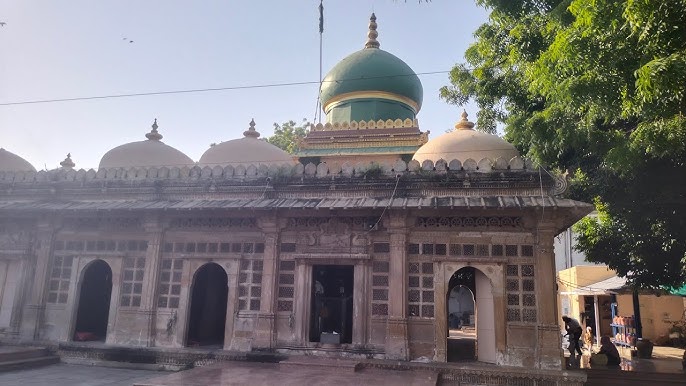
Wajihuddin's Tomb, also known as Hazrat Wajihuddin Dargah, is the resting place of the revered Sufi saint Wajihuddin Alvi. It is situated in the Khanpur area of Ahmedabad, India,
Wajīh al-Dīn ʿAlawī Gujarātī, born in 1504 in Ahmedabad, was a distinguished Sufi saint and scholar who played a significant role in the spiritual and intellectual life of Gujarat. He was born into a family of Sufi scholars and jurists who enjoyed the patronage of the Sultanate of Gujarat, which greatly influenced his early education and spiritual development. Wajihuddin's most notable contribution was the establishment of the ʿAlawī Madrasa in 1528, which became one of Ahmedabad's leading Islamic centers of learning for over 150 years. This madrasa was not only a place for religious education but also an important hub for the spread of Sufi mysticism and Islamic scholarship in the region. In his youth, Wajihuddin explored various Sufi orders, but it was his initiation into the Shaṭṭāriyya order by the renowned Sufi master Muhammad Ghawth Gwāliyārī that profoundly shaped his spiritual journey. Wajihuddin was deeply devoted to the unity of God, man, and the universe, teaching the practice of dhikr?the repetition of God's names?as a way to attain divine awareness. Though he was a Sunni Muslim and a staunch proponent of the Hadith, he emphasized the universal message of peace and unity in Islam. He strongly opposed sectarianism, advocating for "total peace" and rejecting discrimination against various Islamic movements, such as the Mahdawi movement. During the Mughal conquest of Gujarat in 1572-1573, Wajihuddin played a significant political role when he sheltered the sons and supporters of the former Sultan of Gujarat, Muẓaffar Shāh III. This act of defiance against the Mughals led to his summons by Emperor Akbar, although he was eventually released without punishment. Wajihuddin's influence in both spiritual and political realms was a testament to his importance during a turbulent period in Gujarat's history. He spent his final years at his madrasa, where he passed away in 1590. Following his death, his disciples and descendants honored his legacy by building a tomb in his memory, known as Hazrat Wajihuddin Dargah. The tomb was constructed by his disciple, Syed Murtuza Khan Bukhari, who served as the eleventh governor of Ahmedabad under Jahangir (1606-1609). The architectural design of the tomb is notable for its central dome, which is much higher than the surrounding domes, symbolizing Wajihuddin's elevated spiritual status. The tomb's walls are adorned with intricate perforated stone windows, allowing light and air to flow freely, creating a serene atmosphere. One of the unique features of the tomb is an underground reservoir and cistern, believed to have healing properties and never to have dried up, adding to the mystique of the site. The nearby mosque, built by Wajihuddin's grandson Shaikh Haidar, further commemorates his legacy. This mosque was famously visited by Emperor Jahangir in 1608, reinforcing the significant status of Wajihuddin's family and their contributions to the region's religious and architectural heritage. Today, Wajihuddin's tomb and his madrasa stand as monuments not only to his piety and scholarly achievements but also to the enduring legacy of Sufism in Gujarat, representing his commitment to peace, unity, and spiritual enlightenment.
Year of Built: 16th Century
Address: Hazrat Shah vajihuddin,Old city,Khanpur, Ahmedabad, Gujarat, India
Country: India
State: Gujarat
District: Ahmedabad
Pincode: 389230
Longitude: 72.578848
Latitude: 23.028396