
Indo Islamic Heritage


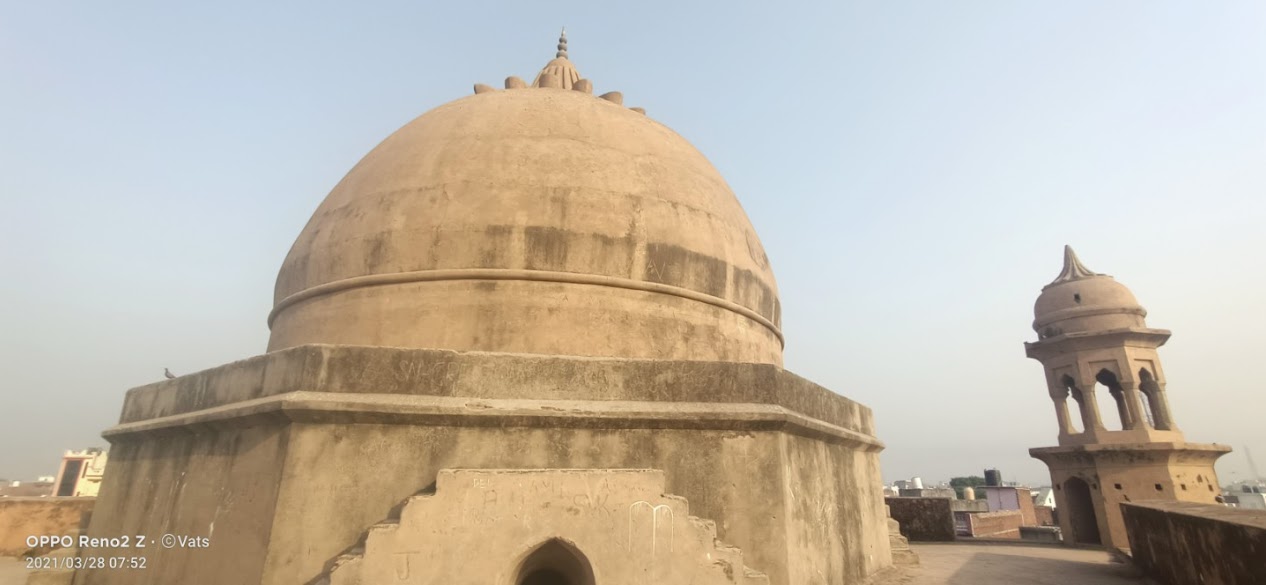
The Tomb of Ikhlas Khan, also known as Roza Ikhlas Khan, is a Mughal-era mausoleum in Badaun, Uttar Pradesh, built in 1690 AD (1094 Hijri) by the wife of Nawab Ikhlas Khan, the Mughal governor of Bengal under Emperor Aurangzeb. This square brick structure, elevated six feet above ground and measuring approximately 150-153 feet on each side, features four corner minarets and houses five graves, including those of Ikhlas Khan, his wife, and their son Shahwaz Khan. Protected by the Archaeological Survey of India (ASI), it exemplifies late Mughal funerary architecture with restrained elegance.
The Tomb of Ikhlas Khan stands as a poignant testament to Mughal architectural patronage in the late 17th century, commissioned as a memorial by the widow of Nawab Ikhlas Khan following his death around 1660-61. Ikhlas Khan, a prominent noble in the court of Aurangzeb, served as the governor of Bengal and amassed significant influence during the emperor's reign. His wife, whose name is not prominently recorded in historical accounts, undertook the construction nearly three decades after his passing, reflecting deep familial devotion and the era's tradition of spousal endowments for mausolea. Architecturally, the tomb adheres to the Mughal paradigm of symmetrical grandeur while maintaining a modest scale befitting a noble's resting place rather than imperial splendor. The edifice is a chabutara-style platform raised six feet from the surrounding terrain, supporting a vast square plinth roughly 150 feet (approximately 46 meters) in length and width. Constructed primarily from locally sourced bricks—a practical choice in the Gangetic plains—the structure's exterior is unadorned by extensive marble inlays, yet it evokes the iconic profile of the Taj Mahal through its four octagonal minarets rising from the corners. These minarets, tapering elegantly, serve both aesthetic and functional purposes, framing the central dome that crowns the mausoleum and providing vantage points for spiritual contemplation. Internally, the tomb chamber is a serene enclosure centered around five cenotaphs: the principal grave of Ikhlas Khan, flanked by those of his wife—the patron—and their son Shahwaz Khan, with two additional unnamed burials likely of family retainers. The layout follows orthodox Islamic funerary norms, with mihrab niches oriented toward Mecca and minimal ornamentation limited to geometric stucco work and arched gateways. Unlike more opulent contemporaries, such as the tombs in Delhi's Nizamuddin complex, this mausoleum prioritizes solidity over lavish decoration, its brickwork plastered in lime to withstand Badaun's humid subtropical climate. Designated a protected monument by the ASI in recognition of its historical integrity, the Tomb of Ikhlas Khan remains a local landmark in Badaun, a city with roots in the Delhi Sultanate era. Though overshadowed by grander sites, it preserves the nuanced interplay of power, piety, and permanence in Mughal India, inviting reflection on the transient lives of its builders amid enduring stone. Visitors today access it via the quiet lanes of Katrabrahmpur, where the structure's isolation enhances its meditative aura, free from the crowds that define more famous Islamic heritage sites.
Year of Built: Not Available
Address: 24MM+W9J, Katrabrahmpur, Budaun, Uttar Pradesh 243601
Country: India
State: Uttar Pradesh
District: Budaun
Pincode: 243601
Longitude: 79.1225° E
Latitude: 28.0369° N