
Indo Islamic Heritage


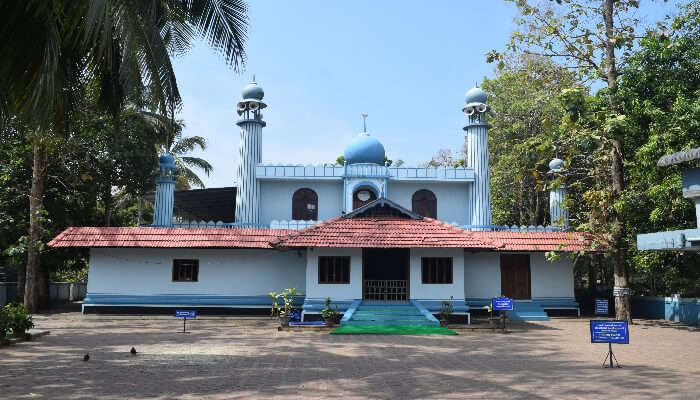
Cheraman Juma Masjid, situated in Kodungallur, Thrissur district, Kerala, is recognized as the oldest mosque in India, constructed in 629 CE. Its architecture uniquely blends traditional Kerala style with Islamic influences, featuring elements like hanging lamps. The mosque is named after Cheraman Perumal, a Chera dynasty king who, according to legend, embraced Islam after witnessing the splitting of the moon. This historic site continues to serve as a place of worship and stands as a testament to India's rich cultural and religious heritage.
Cheraman Juma Masjid, located in Methala, Kodungallur Taluk, Thrissur district of Kerala, holds the distinction of being the first mosque established in India. Built in 629 CE by Malik Bin Dinar, a Persian companion of Prophet Muhammad, the mosque symbolizes the advent of Islam in the Indian subcontinent. The mosque's inception is intertwined with the legend of Cheraman Perumal, a Chera dynasty king. As per tradition, Cheraman Perumal witnessed a miraculous splitting of the moon, an event referenced in Islamic texts. Intrigued, he consulted Arab traders who enlightened him about Islam and Prophet Muhammad. Compelled by this revelation, the king traveled to Mecca, embraced Islam, and adopted the name Tajuddin. Before his demise in Arabia, he instructed his companions to propagate Islam in his homeland. Malik Bin Dinar and his associates fulfilled this wish by establishing the Cheraman Juma Masjid upon their arrival in Kerala. Architecturally, the mosque is a remarkable fusion of traditional Kerala and Islamic styles. Constructed primarily of wood, it features a gabled roof and a spacious prayer hall. The interiors are adorned with brass oil lamps, reminiscent of Hindu temple aesthetics, reflecting the harmonious amalgamation of cultural influences. Notably, the mosque retains a traditional pond and a lamp that has been alight for over a millennium, with oil contributions from devotees of various faiths, symbolizing communal harmony. Over the centuries, Cheraman Juma Masjid has undergone several renovations to preserve its structural integrity and historical essence. Despite these restorations, the mosque has retained its original charm and continues to be a significant center for spiritual activities. It stands as a testament to the early arrival of Islam in India and the syncretic culture of Kerala, where diverse religious traditions have coexisted peacefully. Today, the mosque attracts visitors from across the globe, including historians, architects, and spiritual seekers. Its serene ambiance, coupled with its rich historical and cultural significance, offers a unique glimpse into India's pluralistic heritage. The mosque remains an active place of worship, with regular prayers and community gatherings, continuing its legacy as a beacon of faith and unity. In conclusion, Cheraman Juma Masjid is not merely an architectural marvel but also a symbol of India's early interactions with Islam. Its enduring legacy reflects the country's rich tapestry of cultural and religious diversity, making it a cherished monument in India's historical and spiritual landscape.
Year of Built: 629 CE
Address: Kodungallur - Shornur Rd, Kavilkadavu, Kunnumpuram, Kodungallur, Kerala, India
Country: India
State: Kerala
District: Thrissur
Pincode: 680664
Longitude: 76.1990
Latitude: 10.2220