
Indo Islamic Heritage


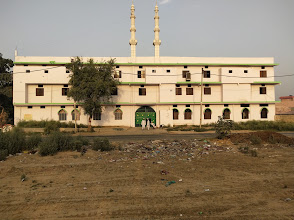
Madrasa Islamia Arabia Faz-e-Aam is a modest local Islamic educational institution and mosque situated in Tajpur village, Bulandshahr district, Uttar Pradesh. It serves as a community hub for Quranic studies, Arabic language instruction, and daily prayers, embodying the grassroots tradition of Deobandi-influenced madrasas prevalent in rural Uttar Pradesh. Established to preserve Islamic scholarship post-1857 revolt, it focuses on traditional religious education for local youth.
Madrasa Islamia Arabia Faz-e-Aam, often referred to locally as a simple yet vital center for Islamic learning, is nestled in the agrarian heartland of Tajpur village within Bulandshahr district. This institution exemplifies the enduring legacy of madrasas in Uttar Pradesh, which proliferated in the late 19th century as responses to colonial disruptions following the 1857 Indian Rebellion. While grander seminaries like Darul Uloom Deoband (founded 1866) set the national template for Sunni Hanafi scholarship, smaller outfits like this one catered to rural Muslim communities, emphasizing the Dars-e-Nizami curriculum—a structured syllabus covering Tafsir (Quranic exegesis), Hadith, Fiqh (Islamic jurisprudence), and Arabic grammar. The madrasa operates primarily as a residential school for boys, with classes from introductory Nazra (Quran recitation) to advanced Fazil (equivalent to a master's in Islamic studies). Its attached mosque facilitates five daily Salah and Jumu'ah prayers, fostering a serene environment for spiritual reflection amid the surrounding fields of wheat and sugarcane. Teachers, known as Ustadhs, hail from nearby Deobandi-affiliated institutions, ensuring adherence to orthodox Sunni practices without sectarian deviations. The architecture is unpretentious: a single-domed prayer hall with whitewashed walls, arched mihrab, and basic ablution areas, reflecting the functional ethos of post-Mughal Islamic structures in the Doab region. Historically, such madrasas emerged in Bulandshahr—a district with roots tracing to pre-1200 BCE Pandava settlements and later Jat principalities—to counter missionary schools and preserve Islamic identity. Though not as documented as urban counterparts, it aligns with the network of over 16,000 recognized madrasas under the Uttar Pradesh Board of Madrasa Education, many approved for higher degrees by institutions like Maulana Azad National Urdu University. Today, it supports around 50-100 students annually, providing free boarding and emphasizing moral education alongside basic secular subjects like Urdu and mathematics, in line with modern board regulations.
Year of Built: Not Available
Address: Tajpur, Alipur Gijhauri, Uttar Pradesh 203001
Country: India
State: Uttar Pradesh
District: Bulandshahr
Pincode: 203001
Longitude: 77.8500° E
Latitude: 28.3667° N